
Table of Contents
- What Scientifically Roasted Coffee Beans Actually Means
- Why Coffee Roast Profile Determines Everything in the Cup
- How Roast Level Affects Coffee Flavour and Body
- Coffee Roasting and Antioxidants: What the Evidence Shows
- Consistent Coffee Roasting and the End of Daily Dialling In
- Caffeine, Focus and Metabolism: What Roasting Does Not Change
- How to Choose and Brew Scientifically Roasted Beans
- Conclusion
- Frequently Asked Questions
Last Updated: October 7, 2026
What Scientifically Roasted Coffee Beans Actually Means
Scientifically roasted coffee beans are green coffee beans roasted to a defined, measured and repeatable profile, where temperature, airflow and time are recorded and reproduced batch after batch rather than judged by eye and ear alone. The result is a bean whose chemical development is deliberate, not accidental.
That definition matters because "scientifically roasted" is not a certification, a grade or a protected term. It describes a method. At Garage Roasters, a family-owned business established in 2015, our roasting is led by a trained and practising medical doctor who treats each batch as an experiment: fixed inputs, logged variables, repeatable outputs. The approach has been refined over thousands of research roasts.
Below, we break down what the roast profile actually controls, how roast level changes flavour and body, what the evidence on antioxidants really supports, and how to choose and brew beans that behave consistently.
Why Coffee Roast Profile Determines Everything in the Cup
Coffee roast profile is the record of how a batch of coffee beans moves through the roaster: the charge temperature, the rate of rise, the point at which first crack begins, the total roasting time and the drop temperature.
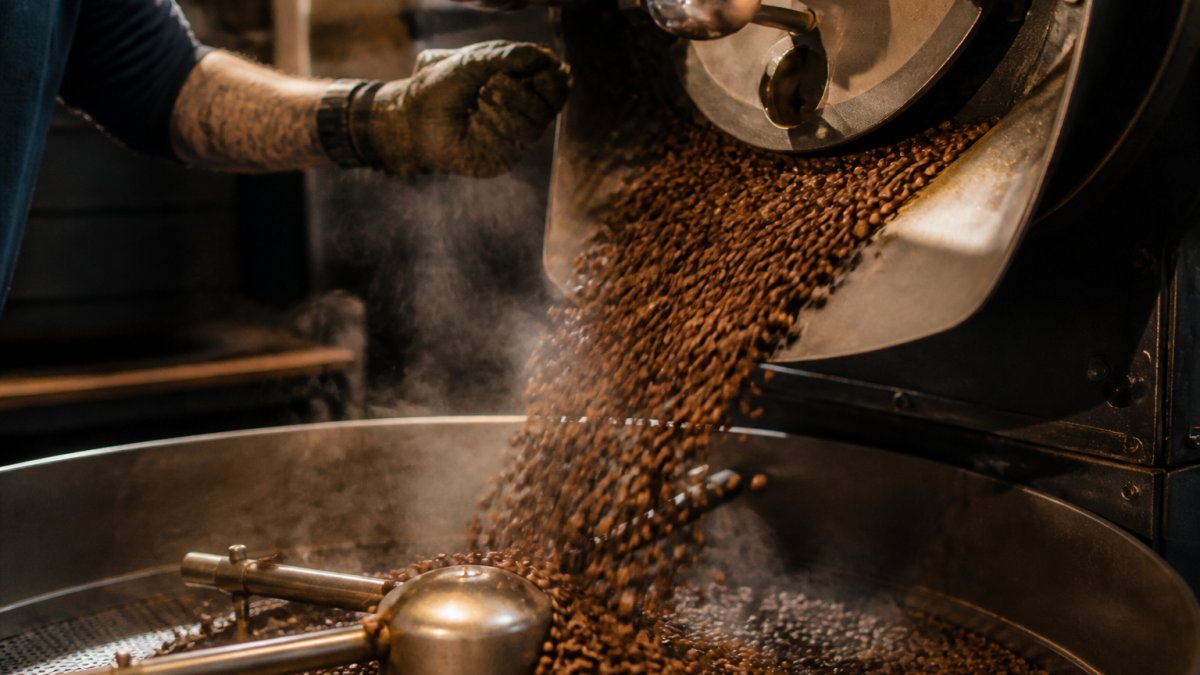
Green coffee has no roast flavour. What you taste in the cup is created during roasting, as heat drives moisture out of the bean and triggers hundreds of simultaneous chemical reactions.
Because those reactions are time-and-temperature dependent, the profile decides the outcome.
Roasting Variables That Change the Outcome
Four variables do most of the work:
- Charge temperature: how hot the drum is when the beans go in. Too hot and the bean surface scorches before the interior develops.
- Rate of rise: how quickly bean temperature climbs. A stalling rate of rise flattens flavour; a runaway rate of rise rushes development.
- First crack timing: the audible point where moisture and gases escape. When it happens, and how long development continues after it, shapes acidity and body.
- Drop temperature and total time: where and when the roast ends. This is the single biggest lever on roast level.
Reproducibility is the part most home and small-batch roasters struggle with. Without logged data, a "medium roast" is a guess that shifts with ambient temperature, batch size and bean density. With logged data, it is a specification.
How Roast Level Affects Coffee Flavour and Body
How roast level affects coffee flavour comes down to how far the roast progresses. Light roasts retain more of the bean's original acids and origin character; dark roasts trade that brightness for roast-derived sweetness, bitterness and heavier body. Medium roasts sit between the two, which is why they suit espresso and milk drinks so well.
Light, Medium and Dark: What Changes in the Bean
As roasting progresses, the bean loses moisture and mass, expands in volume, and darkens as Maillard products and caramelised sugars accumulate. Organic acids, including chlorogenic acids, degrade progressively with heat and time. Meanwhile, new compounds form, including melanoidins, the brown polymers responsible for much of the colour, body and bitterness in darker roasts.
The practical trade-off is straightforward:
- Light roast: higher acidity, lighter body, more distinct origin notes. Less forgiving to brew, because under-extraction is easy to hit.
- Medium roast: balanced acidity and sweetness, medium body. The widest margin for error across brewing methods.
- Dark roast: lower acidity, heavier body, roast-forward flavours. Easier to extract, but origin character is largely obscured.
Our own range reflects that logic. The Costa Rica Volcan Azul Geisha Natural is roasted medium for espresso, with tasting notes of florals, jasmine, tropical fruit, lime and red currants, and an optimal drinking window of one to five weeks post roast. The Pour Over, by contrast, is roasted light for filter, a washed Kenyan with white currant and mandarin notes and a one-to-six week window.

Coffee Roasting and Antioxidants: What the Evidence Shows
Coffee roasting and antioxidants are linked in a way that is genuinely more complicated than most summaries admit. Coffee is a major dietary source of chlorogenic acids and other polyphenols, but roasting degrades a meaningful portion of them. At the same time, roasting creates new compounds, including melanoidins, that also show antioxidant activity in laboratory settings.
So the honest answer to "does roasting destroy coffee's antioxidants" is: partly, and it also creates different ones. Total antioxidant capacity measured in a lab does not map cleanly onto health outcomes in people, and the two are frequently conflated in consumer writing.
Chlorogenic Acids, Melanoidins and the Limits of Current Research
Chlorogenic acids are the best-studied polyphenols in coffee and are present in higher concentrations in green coffee than in roasted coffee. Melanoidins are formed during roasting and increase as the roast darkens. Trigonelline, another compound in green coffee, also degrades with roast intensity and contributes to the bitter, roasty notes in darker profiles.
Where the research runs out is in translating these measurements into health claims. Most human studies on coffee and long-term health look at coffee consumption generally, not at specific roast levels.
If you want to read the primary literature rather than summaries, PubMed, the US National Library of Medicine's research database indexes the peer-reviewed studies on coffee phytochemicals and roasting chemistry. For plain-language guidance on what coffee consumption means for health, the Australian Dietary Guidelines from the National Health and Medical Research Council set out the broader dietary context.
Costa Rica Volcan Azul Geisha Natural →
Consistent Coffee Roasting and the End of Daily Dialling In
Consistent coffee roasting means the bean you grind today behaves like the bean you ground last week, so your grinder setting and brew recipe stay put. That is the practical payoff of a controlled profile, and it is the part that changes your morning routine.
Anyone who has chased a good espresso shot knows the pattern. You dial in the grinder, land a shot you are happy with, and then the next bag arrives and the whole process restarts. Some of that is normal: coffee changes as it rests, and every bean ages.
When the roast profile is fixed and logged, that variable largely disappears. Our methodical approach is built around this: the aim is that you set your grinder once for a given coffee and adjust only as the beans naturally age.
Caffeine, Focus and Metabolism: What Roasting Does Not Change
Caffeine content is largely unaffected by roast level. Caffeine is thermally stable at roasting temperatures, so a light roast and a dark roast of the same green coffee contain broadly similar caffeine by weight.
What roast level does change is the perception of strength. Darker roasts taste bolder and more bitter, which reads as stronger.
Claims about coffee and metabolism or energy expenditure are frequently overstated. Coffee contains caffeine, a well-documented stimulant, and stimulants affect alertness and reaction time. Beyond that, the evidence for coffee meaningfully changing metabolism in a way that affects body composition is weak and inconsistent.
On cognitive performance, the effect people notice is real but temporary: caffeine improves alertness and can improve reaction time, and it does not replace sleep. Roasting does not change any of this.
How to Choose and Brew Scientifically Roasted Beans
Choosing well comes down to matching the roast to your brewing method, then checking that the roaster gives you the information to reproduce results. Here is the checklist we would use:
- Match roast to brew method. Light roasts for filter and pour over; medium roasts for espresso and milk drinks. A light roast pushed through an espresso machine without recipe adjustment usually tastes sour and thin.
- Check for a roast date, not a best-before date. Freshness is measured from roast, and the drinking window is typically weeks, not months.
- Look for a stated brew recipe. Dose, yield, temperature and time give you a starting point instead of a guessing game.
- Confirm the roast level is stated. If a roaster will not tell you the roast level, they are unlikely to have logged the profile.
- Buy a size you will finish inside the window. A 250 g bag drunk within a month beats a kilogram bag that stales.
Our Ethiopian Single Origin Espresso is a good example of a specification you can actually use: medium roast, natural process, tasting notes of cocoa, candy citrus, limoncello and apricots, with a recommended recipe of 20 g dose, 33 g yield, 92C, 28-31 seconds.

For a fuller picture of how roast chemistry is studied and reported, the scientific journal Food Chemistry publishes much of the primary research on coffee roasting and compound formation.
| Brew Method | Roast Level | Dose | Yield / Water | Temperature | Time |
|---|---|---|---|---|---|
| Espresso | Medium | 20 g | 33-45 g | 92C | 26-31 seconds |
| Pour over / filter | Light | 15 g | 240 g water | 92C | 3:15 total |
| Milk-based drinks | Medium | 20 g | 34 g | 92C | 26-29 seconds |
One more note on storage: keep beans whole, sealed and away from light and heat, and grind immediately before brewing. Compostable packaging is worth seeking out, and our own range ships in fully compostable packaging, but check the certification on any bag claiming it rather than taking the word on the label.
Conclusion
The gap between a coffee you fight with every morning and one that simply works is usually a roasting problem. A controlled, logged roast profile gives you a bean that behaves predictably, so your grinder setting holds and your shots land where you left them.
Garage Roasters roasts that way by design: a research-based, methodical process led by a scientist, top-grade African and Colombian single origins, and fully compostable packaging. If you are tired of dialling in from scratch every week, start with our Out of Africa Blend or explore the full range and pick the roast level that matches your setup.

Frequently Asked Questions
What are the benefits of scientifically roasted coffee beans?
Scientifically roasted coffee beans are roasted with measured control over temperature, time and airflow, which produces a repeatable roast profile batch after batch. The practical benefits are consistent flavour, predictable extraction so you spend less time dialling in. You also get a clearer picture of what is actually in the cup, because the roast variables are documented rather than guessed.
How does roast level affect coffee flavour and antioxidants?
Roast level drives flavour first: lighter roasts keep more of the bean's origin character, with brighter acidity and fruit notes, while darker roasts push toward chocolate, caramel and smoke as sugars caramelise. On the antioxidant side, chlorogenic acids degrade as roasting progresses, so lighter roasts generally retain more of them than dark roasts. The trade-off is that lighter roasts can taste sharp or underdeveloped if the roast profile is not controlled properly.
Does scientific roasting make coffee taste more consistent?
Yes, when the roaster logs and repeats the same roast profile. Consistent coffee roasting means each batch follows the same temperature curve and development time, so the beans you buy in March behave like the beans you bought in January. In practice that means your grinder setting and shot time stay stable instead of shifting every week. It does not remove the need to dial in a new bag.
Can roasting affect the caffeine content of coffee?
Roasting has only a small effect on caffeine. Caffeine is heat-stable at roasting temperatures, so light, medium and dark roasts of the same green coffee end up with broadly similar caffeine levels. What changes is the weight and volume of the bean as it loses moisture and expands, so if you measure by scoop rather than by weight, a darker roast can deliver slightly more caffeine per scoop. Weighing your dose in grams removes that variable entirely.