
Table of Contents
- Step 1: Understand What Destroys Coffee Freshness
- Step 2: Choose the Best Coffee Storage Containers
- Step 3: How Long Do Coffee Beans Last?
- Step 4: Freezing Coffee Beans for Long-Term Storage
- Step 5: Whole Bean vs Pre-Ground Coffee
- Is Compostable Coffee Packaging Actually Effective?
- Common Coffee Storage Mistakes to Avoid
- Conclusion
- Frequently Asked Questions
Last Updated: September 29, 2026
Step 1: Understand What Destroys Coffee Freshness
Four things ruin coffee: light, heat, moisture, and oxygen. Learning how to store coffee beans properly means blocking all four, every single day.
Roasted beans are porous. They release carbon dioxide in a process called degassing, and while that happens, oxygen sneaks in and starts oxidising the oils that carry flavour. That is why stale coffee tastes flat and papery instead of sweet and bright.
Light breaks down those same oils. UV light is the worst offender, which is why clear glass jars on a sunny bench are a bad idea. Heat speeds up every chemical reaction, including the ones you don't want.
Then there's moisture. Beans left near a kettle or dishwasher pull water from the air, and condensation wrecks both flavour and grind consistency.
So the rule is simple: keep beans dark, cool, dry, and sealed.
Step 2: Choose the Best Coffee Storage Containers
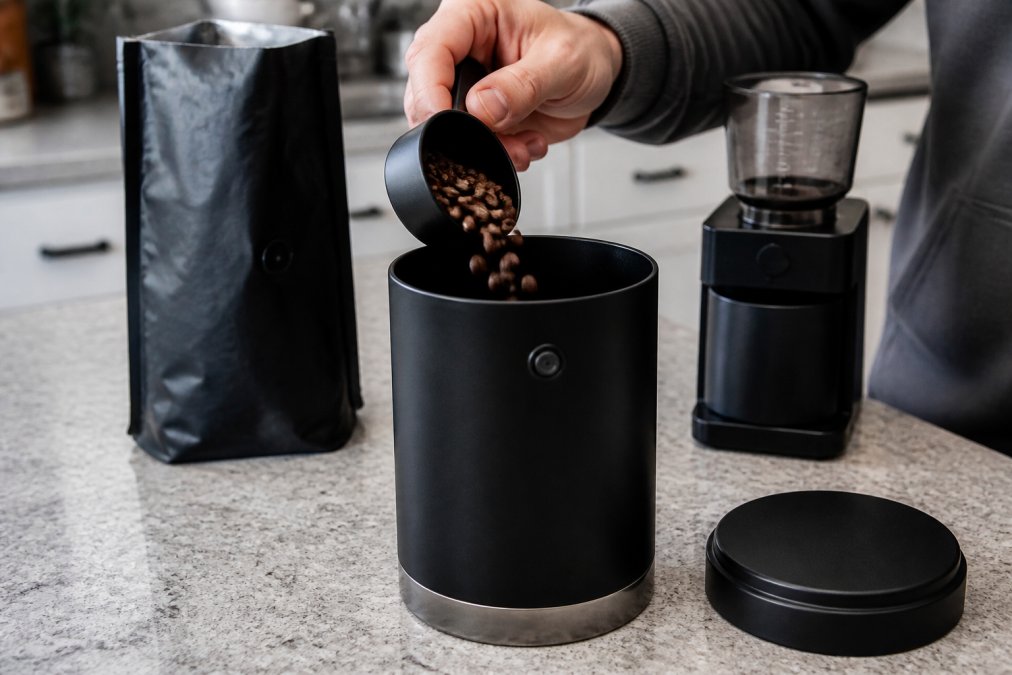
The best coffee storage containers are opaque, airtight, and sized to hold only what you'll drink in a week or two. Skip anything clear, oversized, or loosely sealed. But the material you choose does more work than most guides admit, so it's worth understanding what each option actually does to a bean.
Look for these features:
- Opaque body to block UV light
- Airtight seal to keep oxygen out
- One-way valve to let carbon dioxide escape
- Right-sized capacity so there's little headspace
Container Material Science: What Actually Protects the Bean
Stainless steel blocks light completely, is non-porous, and won't absorb or transfer odours. It's the most reliable everyday choice. The trade-off is that it's opaque, so you can't see how much is left, and cheaper grades can feel flimsy at the seal. Look for a silicone or rubber gasket rather than a metal-on-metal lid.
Ceramic performs similarly to steel on light and odour, and the weight helps it sit still on a bench. The catch is the glaze: a poorly fired interior can be slightly porous, and a chipped rim can harbour stale oils. It's also heavy and breakable, which matters if you store beans on a high shelf.
Glass is the material most people reach for and the one that needs the most caveats. Clear glass transmits visible and UV light almost completely, and UV is the part of the spectrum that breaks down the oils carrying flavour. Tinted glass (amber or dark green) reduces this, but only if it's genuinely tinted through the body rather than coated. If you use glass, treat it as a cupboard container, not a bench display. A clear jar on a sunny windowsill is the worst of both worlds: light exposure plus temperature swings.
Plastic is cheap and light, but it scratches. Those micro-scratches trap old oils and aromas, and over months the container itself starts to smell like stale coffee. If you go plastic, choose a food-grade, BPA-free option and replace it when the interior dulls.
Vacuum-sealed canisters remove most of the air rather than just sealing it out, which slows oxidation further than a standard airtight lid. The trade-off is that a hard vacuum can pull oils to the surface and, if you open and reseal frequently, the pump mechanism becomes the weak point. They suit people who store a large batch and decant small amounts.
A quick comparison of what each material blocks:
| Material | Blocks light | Blocks oxygen | Odour-safe | Notes |
|---|---|---|---|---|
| Stainless steel | Yes | With good seal | Yes | Best all-rounder |
| Ceramic | Yes | With good seal | Usually | Check glaze quality |
| Tinted glass | Partly | With good seal | Yes | Keep in cupboard |
| Clear glass | No | With good seal | Yes | Display only |
| Plastic | If opaque | With good seal | Fades over time | Scratches trap oils |
| Vacuum canister | Depends on body | Yes, actively | Yes | Best for bulk |
Why One-Way Valves Matter
A one-way valve lets carbon dioxide out but keeps oxygen from getting in. Without it, gas builds up inside a sealed container and forces the lid open, or the pressure simply pushes stale air back through the seal.
Most quality coffee bags already have a valve. That's why the original bag often beats a fancy canister, provided you squeeze the air out and reseal it properly. If you're buying a canister, check that the valve is a genuine one-way membrane rather than a simple hole with a flap, which can let air back in once the internal pressure drops.
Step 3: How Long Do Coffee Beans Last?
Whole beans stay at their best for about two to four weeks after the roast date. After that, they don't become unsafe, they just lose aroma and complexity.
Ground coffee ages much faster, often going flat within a week. More on that below.
A few things stretch that window:
- Keep the bag sealed between uses
- Store it away from the stove and kettle
- Buy smaller amounts more often
- Check the roast date, not the best-before date
Coffee bean shelf life depends heavily on how the beans are stored and how dark they're roasted. Treat the roast date as your starting gun, not the purchase date.
Turin DF54 V4 Single Dose Grinder →
Roast Level and Storage: Why Dark and Light Beans Age Differently
Dark roasts age faster. The longer roasting time brings more oils to the surface, and those surface oils oxidise quickly.
Light roasts are denser and hold their character longer, often a week or two beyond a dark roast. If you buy light single origins, you have a little more breathing room.
This is why a dark espresso blend can taste amazing on day five and dull by day twenty, while a light filter roast still sings at three weeks.
Step 4: Freezing Coffee Beans for Long-Term Storage
Yes, you can freeze coffee beans, and it works well when done correctly. The key is portioning and sealing before anything goes in the freezer.
Freezing coffee beans slows oxidation to a crawl.
Follow these steps:
- Divide beans into single-session portions
- Seal each portion in an airtight, opaque bag
- Squeeze out as much air as possible
- Label with the roast date
- Freeze immediately
The Batch Portioning Method
Portion by what you'll grind in one go. If you pull two double shots a day, that's roughly 36 grams per portion.
Step 5: Whole Bean vs Pre-Ground Coffee
Whole bean coffee stays fresh far longer than pre-ground. Grinding exposes the bean's surface area to oxygen, and that surface area is where staling starts.
The difference is dramatic:
| Factor | Whole Bean | Pre-Ground |
|---|---|---|
| Peak freshness | 2-4 weeks | 3-7 days |
| Surface exposure | Low | Very high |
| Best storage | Airtight, dark, cool | Airtight, dark, cool, use fast |
| Flavour retention | Strong | Fades quickly |
Is Compostable Coffee Packaging Actually Effective?
Compostable packaging can protect coffee well, but only when it includes a proper oxygen barrier and a one-way valve. Without those, it's a sustainability win with a freshness cost.
Common Coffee Storage Mistakes to Avoid
The fridge is the biggest mistake. Coffee is hygroscopic, meaning it pulls moisture and odours from everything around it, and a fridge is full of both. Every time you open the door, the beans also cycle through temperature changes that drive condensation onto their surface.
Other common errors:
- Storing beans in the freezer door, where temperature swings constantly
- Using a clear glass jar on an open shelf
- Buying a month's supply and grinding it all at once
- Leaving the bag open between scoops
- Trusting the best-before date over the roast date
Climate-Specific Storage: When 'Cool and Dry' Isn't Enough
The standard advice assumes a mild, low-humidity kitchen. In much of the country that assumption fails for months of the year, and the usual tips quietly stop working.
Buy less, more often. Freshness is a supply-chain habit, not a container you can buy once.
Conclusion
The real challenge isn't finding a clever container. It's building a routine that keeps oxygen, light, heat, and moisture away from your beans every single day.
Frequently Asked Questions
Should I keep coffee beans in their original packaging?
Yes, if the bag has a one-way valve and is resealable. The valve lets carbon dioxide escape after roasting while blocking oxygen entry, which slows oxidation and keeps beans fresher for longer. Once opened, squeeze out excess air before sealing, or transfer to an airtight container if the bag does not reseal well. For best results, use beans within two to four weeks of the roast date.
Is it better to keep coffee beans in the fridge or freezer?
The fridge is a poor choice because moisture and odours from other food can seep into the beans, and condensation forms each time you remove them. The freezer works well for long-term storage if you portion beans into airtight, vacuum-sealed bags and let them come to room temperature before opening. This limits moisture exposure and preserves flavour for up to three months.
What is the 15-15-15 coffee rule?
The 15-15-15 rule is a freshness guide: green coffee stays fresh for about 15 months, roasted whole beans for 15 weeks, and ground coffee for 15 minutes before noticeable staling begins. While the ground coffee figure is an exaggeration, it highlights how quickly grinding accelerates oxidation and aroma loss. For the best cup, grind just before brewing and store whole beans properly.
How does oxygen and light affect coffee bean degradation?
Oxygen causes oxidation, which breaks down oils and aromatic compounds, turning beans stale and flat. Light, especially UV, accelerates this process by degrading the oils further. Storing beans in an opaque, airtight container in a cool, dark pantry minimises both. Clear glass jars on a sunny bench are one of the fastest ways to ruin fresh coffee.