
Last Updated: November 9, 2026
Quick Summary
Specialty grade coffee is coffee that scores 80 points or higher on a 100-point scale, assessed by trained graders for both physical bean quality and cup quality. A licensed grader, usually a Q Grader, cups the roasted sample and builds the score attribute by attribute, then deducts defects. A lot that arrives at 80 or above after deductions is specialty grade; below that, it is commercial coffee.
- The five cup-quality attributes are each multiplied by 4, contributing up to 40 points apiece.
- Uniformity, clean cup and sweetness are each multiplied by 2, contributing up to 20 points apiece.
- Graders count defects per 350 grams, separating primary defects from secondary ones.
- Green coffee is typically traded in a moisture range around 10 to 12 per cent.
- Screen size is not a quality score, but it signals consistency and density.
Table of Contents
- What Makes Coffee Beans Specialty Grade
- How Specialty Coffee Grading Works: The 100-Point Scale
- What Is a Specialty Coffee Score and What Do the Numbers Mean
- Coffee Bean Defects: The Physical Checks Before the Cup
- Specialty Coffee vs Commercial Coffee: Where the Line Falls
- The Limits of the 80-Point Rule: What Score Alone Won't Tell You
- Choosing Specialty Grade Beans for Your Bench
- Frequently Asked Questions
What Makes Coffee Beans Specialty Grade
Specialty grade coffee is coffee that scores 80 points or higher on a 100-point scale, assessed by trained graders for both physical bean quality and cup quality.
The Specialty Coffee Association's 2026 National Coffee Data Trends report describes specialty coffee as the coffee of choice in its market, with younger adults driving sustained growth. The catch is that "specialty" gets used loosely by sellers. Here is how the grade is actually decided, and how to check it before you spend money.
How Specialty Coffee Grading Works: The 100-Point Scale
Grading runs on a 100-point scale, but the number is not awarded in one pass. A licensed grader, usually a Q Grader, cups a roasted sample through a standardised ritual: sniffing the dry grounds, breaking the crust on the wet grounds, slurping at several temperatures, and scoring the same coffee across multiple cups. The final figure is built attribute by attribute, then adjusted for defects.
The scoring framework most graders work to is the Specialty Coffee Association's cupping protocol and its cupping form. The form lists the attributes below, each scored on a 6-to-10 scale in quarter-point increments, with 6 meaning 'good' and 10 meaning 'exceptional':
- Fragrance and aroma of the dry and wet grounds
- Flavour, aftertaste, acidity, body and balance
- Uniformity across multiple cups of the same lot
- Clean cup, meaning no off-ferment or taint in any cup
- Sweetness, scored as a baseline quality marker
- Defects, subtracted from the final score
Here is the mechanism that trips people up. The five cup-quality attributes (flavour, aftertaste, acidity, body, balance) are scored out of 10 and then multiplied by a weighting factor of 4, so each contributes up to 40 points. Uniformity, clean cup and sweetness are scored out of 10 and multiplied by 2, so each contributes up to 20 points. That produces a maximum of 100 before defects. A single defective cup in a flight of five can zero out the uniformity score for that attribute, which is why one tainted cup can pull an otherwise strong lot below the line.
Defects are then deducted. The protocol distinguishes full defects from lesser ones, and the deduction depends on defect type and cup impact. A lot that arrives at 80 or above after deductions is specialty grade. Below that, it is commercial coffee, regardless of what the bag says.
A worked example makes the arithmetic concrete. Suppose a washed lot scores 7.5 for flavour, 7.25 for aftertaste, 7.5 for acidity, 7.5 for body and 7.25 for balance. Those five average 7.4, multiplied by 4, gives 29.6 out of a possible 40. If uniformity, clean cup and sweetness each score 10, that adds 60, for 89.6 before defects. Two secondary defects might deduct 2 points, landing the lot at 87.6, comfortably specialty. A different lot with the same sensory scores but three defective cups could lose uniformity points and drop under 80. The score is a sum of decisions, not a single impression.
Watch out: the 80-point threshold is a gate, not a full description of quality. Two coffees can both score 84 and taste completely different, because the score compresses aroma, acidity, body and balance into one figure. Ask for the attribute breakdown if you want to know whether a coffee is bright and delicate or heavy and sweet before you buy.
What Is a Specialty Coffee Score and What Do the Numbers Mean
A specialty coffee score is the numeric output of that cupping, and it bands coffees into rough quality tiers. The bands matter more than the exact digit.
| Score | Grade | What it means in the cup |
|---|---|---|
| 90-100 | Outstanding | Exceptional complexity, clean and layered |
| 85-89.99 | Excellent | Distinctive origin character, high clarity |
| 80-84.99 | Very good | Solid specialty, clean and sweet |
| Below 80 | Commercial | Defects or flatness present |
Research on the Cup of Excellence program found that both material quality attributes and symbolic attributes influence specialty coffee scores and prices, which is a polite way of saying a famous farm name can lift a price beyond what the cup alone justifies (Traore and colleagues' Cup of Excellence study). That is the first caveat in this whole system.
Coffee Bean Defects: The Physical Checks Before the Cup
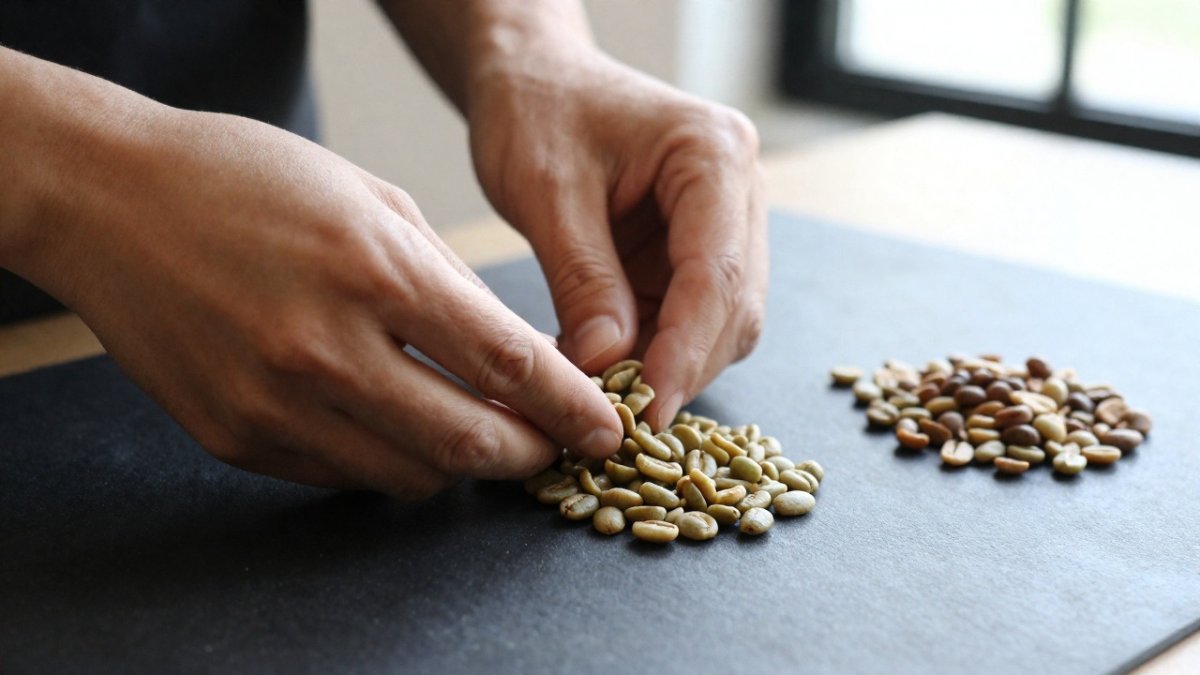
Physical green-bean grading happens before anyone brews anything, and it is a separate gate from cupping. Graders spread a sample on a mat and count defects per 350 grams, separating primary defects from secondary ones. The 350-gram sample size matters: it is the standard reference weight in the green-coffee grading protocol, so defect counts are expressed per 350 grams rather than per bag.
Primary defects include black beans, sour beans, fungus damage, foreign matter and severe insect damage. Secondary defects cover broken beans, husks, mild insect bites and faded beans. A lot with any primary defect category above the tolerance, or too many secondary defects, is disqualified from specialty grading before cupping begins. In practice, a specialty lot is expected to show zero primary defects in the sample and only a small, defined allowance of secondary defects; a commercial lot can carry several primary defects per 350 grams and still be sold.
Beyond defect counting, green-bean grading checks three physical properties that never appear on a cupping form:
- Screen size. Beans are sorted through slotted screens. A screen size of 17 or 18 is large; 15 and below is small. Screen size is not a quality score, but it signals consistency and density, and most specialty lots are sold with a stated screen size.
- Moisture content. Green coffee is typically traded in a moisture range around 10 to 12 per cent. Too wet and the lot risks mould and uneven roast; too dry and it fades quickly. A moisture reading is a shelf-life and consistency check, not a flavour judgement.
- Density. Dense beans usually come from higher altitudes and tend to roast more evenly. Graders assess density by feel and by how the beans behave in water, and buyers use it to predict roast behaviour.
This is the part most buyers never see, and it is where the physical and sensory gates diverge. A lot can pass the screen, moisture and density checks and still score under 80 if the roast was developed poorly or the lot fermented unevenly, because physical sorting only catches what is visible. Equally, a clean-looking lot with a hidden ferment taint will fail on the cupping table, not on the mat. For a deeper look at what separates good green coffee from risky green coffee, read our guide to signs of high quality green coffee.
Watch out: a seller quoting a screen size or a defect count is giving you physical data, not a grade. Ask for the cupping score as well, because the two checks answer different questions.
Specialty Coffee vs Commercial Coffee: Where the Line Falls
The difference between specialty coffee and commercial coffee is not origin, roast level or price tag. It is whether the lot passed both the physical and sensory gates.
Commercial coffee is grown for volume, often blended across regions, and roasted to a uniform dark profile that hides inconsistency. Specialty coffee is traced to a specific lot, processed with care, and roasted to show what that lot actually tastes like.
The Al-Mahish and colleagues study in Beverage Plant Research confirms that specialty beans are graded on a 100-point scale, with 80-100 recognised as specialty grade. That definition is the industry's, not a seller's. If a roaster cannot tell you the score or at least the lot and grade, treat the word "specialty" as decoration.
The Limits of the 80-Point Rule: What Score Alone Won't Tell You
An 80-point score proves a coffee is clean and free of defects. It does not prove you will enjoy it.
Plenty of 82-point coffees are excellent value. Plenty of 88-point coffees are wasted on a bad grinder or a rushed brew. Score measures quality, not fit: a delicate, high-acidity washed Ethiopian at 88 points can taste thin and sharp if you brew it like a chocolatey Brazilian.
Processing and roast also shape the cup without changing the grade. A natural process can push fruit and ferment notes; a light roast preserves acidity while a darker one mutes it. None of that moves the score, but all of it moves your experience.
The honest read: use the score as a filter, then judge with your palate.
Choosing Specialty Grade Beans for Your Bench
Start with the score and the lot, then match the coffee to how you brew. For espresso, look for medium roasts with clear sweetness and enough body to hold up. For filter, lighter roasts with high acidity and delicate aromatics reward the effort.
Our own range is built around this idea. The Ethiopia Kochere Carbonic Grade 1 is a carbonic-macerated Grade 1 with peach, jasmine and black tea notes, roasted medium for espresso. The Costa Rica Volcan Azul Geisha shows what a high-scoring varietal tastes like when the roast gets out of its way. Unsure where to start? A sample pack lets you compare grades side by side.
If you want a broader primer on spotting quality before you buy, our guide on how to identify high quality coffee covers the basics.
Specialty coffee rewards buyers who check the grade instead of the label. At Garage Roasters, every lot is chosen on score and lot traceability, roasted by a scientist using a methodical research-based process, and packed in fully compostable packaging. The result is consistent flavour in every cup, with no daily extraction tweaking required. Get started with Garage Roasters and taste the difference a graded bean makes.
Frequently Asked Questions
What score does coffee need to be considered specialty grade?
Specialty grade coffee must score 80 or above on the 100-point scale used in specialty coffee grading. The scale runs from 80 to 100 for specialty, and anything below 80 is classed as commercial grade. A score of 80 to 84.99 is often called Very Good, 85 to 89.99 Excellent, and 90 and above Outstanding. The score comes from cupping, not from the label on the bag.
Do specialty-grade beans have fewer defects?
Yes. Coffee bean defects are counted during green-bean grading, and specialty coffee allows very few. Under the SCA system, a 350 g sample of specialty green coffee may contain no primary defects at all and only a small number of secondary defects. Primary defects include full black, full sour and fungus-damaged beans. Commercial-grade coffee tolerates far more. Fewer defects mean fewer off-flavours in the cup, which is why physical sorting matters as much as the roast.
Is specialty coffee the same as single-origin coffee?
No. Single-origin describes where the beans come from, while specialty grade describes how good they are after grading. A single-origin coffee can still fail to reach 80 points. Specialty coffee vs commercial coffee is a quality distinction, not a sourcing one. Traceability helps, because a washed Grade 1 lot from a named producer is easier to verify than a blend with no origin detail, but the score and defect count are what actually decide the grade.
Does specialty grade mean the coffee will taste better?
It means the coffee scored 80 or above in cupping, judged on sweetness, acidity, body, balance, aftertaste and clean cup. That is a strong signal, but roast and freshness still shape what lands in your grinder. A specialty grade bean roasted months ago will taste flat. Look for a roast date and a stated drinking window. Garage Roasters lists a one to five week post-roast window on its single origins, which is the practical side of the score.
