
Last Updated: November 11, 2026
Quick Summary
A sustainable coffee subscription in Australia delivers ethically sourced beans on a recurring schedule, and you should judge one on sourcing transparency, packaging credentials, delivery flexibility and cost per cup. Verifiable certification and a printed roast date matter more than vague eco-friendly claims.
- Australia's coffee market is valued at $2.58 billion in 2026 and projected to grow 5.55% annually to 2031.
- Annual certification fees run from $400 to $700 for Organic and $1,000 to $3,000 for Fair Trade.
- Remove the degassing valve and tin tie before composting a certified compostable coffee bag.
- Fortnightly delivery suits espresso drinkers pulling two or more shots a day; monthly suits filter brewers.
- At $18.00 a bag, pour over costs $1.13 per cup and espresso $1.50 per cup.
Table of Contents
- Why a Sustainable Coffee Subscription Makes Sense in 2026
- How We Evaluated These Sustainable Coffee Options
- What Makes an Ethical Coffee Subscription Genuinely Ethical
- Sustainable Coffee Packaging: What to Check Before You Subscribe
- Choosing the Right Coffee Subscription Delivery Frequency
- Why a Specialty Coffee Subscription Beats Supermarket Beans
- Cost Per Cup: Comparing Value Across Sustainable Subscriptions
- Matching Your Subscription to Your Brew Method
- Frequently Asked Questions
Why a Sustainable Coffee Subscription Makes Sense in 2026
A sustainable coffee subscription in Australia is a recurring delivery of ethically sourced, environmentally responsible beans, and the market behind it is growing fast. Australia's coffee market is valued at $2.58 billion in 2026 and is projected to grow at 5.55% annually to 2031, according to Mordor Intelligence's Australian coffee market report.
Here's the tension most guides skip. Sustainability commitments across the coffee trade have multiplied, yet the Coffee Barometer 2026 report found these have not delivered systemic reform across the supply chain. A subscription only counts as sustainable if you can verify the claims behind it.
How We Evaluated These Sustainable Coffee Options
We scored every option against four criteria: sourcing transparency, packaging credentials, delivery flexibility, and cost per cup. No lock-in contract carried real weight, because a subscription you cannot pause is a subscription you regret.
Our own range anchors the comparison. The Harmony Blend is a medium-roast blend of Brazilian, Ethiopian and Indonesian grade 1 beans with notes of nuts, caramel, spice and berries, priced at $18.00, and 10% of profit is donated to Sydney Philharmonia Choirs. The Shelter Blend is priced at $18.00 and 10% of profit goes to Women's Community Shelters. The Symphonic Blend is priced at $18.00 and 10% of profit goes to Sydney Youth Orchestras.
| Criterion | What Good Looks Like | Red Flag |
|---|---|---|
| Sourcing | Named farms or regions, certification stated | Vague "ethically sourced" claims |
| Packaging | Certified compostable or recyclable | Soft plastic with no certification |
| Flexibility | Pause, skip or cancel anytime | Minimum-term lock-in |
| Freshness | Roast date printed on the bag | Best-before dates only |
What Makes an Ethical Coffee Subscription Genuinely Ethical
An ethical coffee subscription is one where the sourcing claims are verifiable, the roaster's relationships are direct, and the environmental promises survive scrutiny. Certification is the starting point, not the finish line.
Sourcing transparency and certification
Certification costs money, and that cost signals commitment. Annual renewal fees run from $400 to $700 for Organic, $500 to $1,500 for Rainforest Alliance, and $1,000 to $3,000 for Fair Trade, according to The Flaming Bean's 2026 certification guide. A roaster paying those fees has a reason to name the certification on the bag. Ask for the certifying body and the certificate number.
Roastery direct and fair trade models
Roastery direct means the business buying the green beans is the business roasting them, which shortens the chain between farm and cup. That matters because supply chain volatility is a real constraint: limited stocks of high-quality, ethically sourced beans make consistent subscription models difficult, as Perfect Daily Grind's reporting on supply chain pressure notes. Transparency about origin helps you judge whether a roaster can actually deliver the same beans next month.
Sustainable Coffee Packaging: What to Check Before You Subscribe
Sustainable coffee packaging is the area where marketing outruns reality most often. Ask one question: is the bag certified compostable, or just described as eco-friendly? A bag labelled "compostable" without a certification mark is a claim, not a fact.
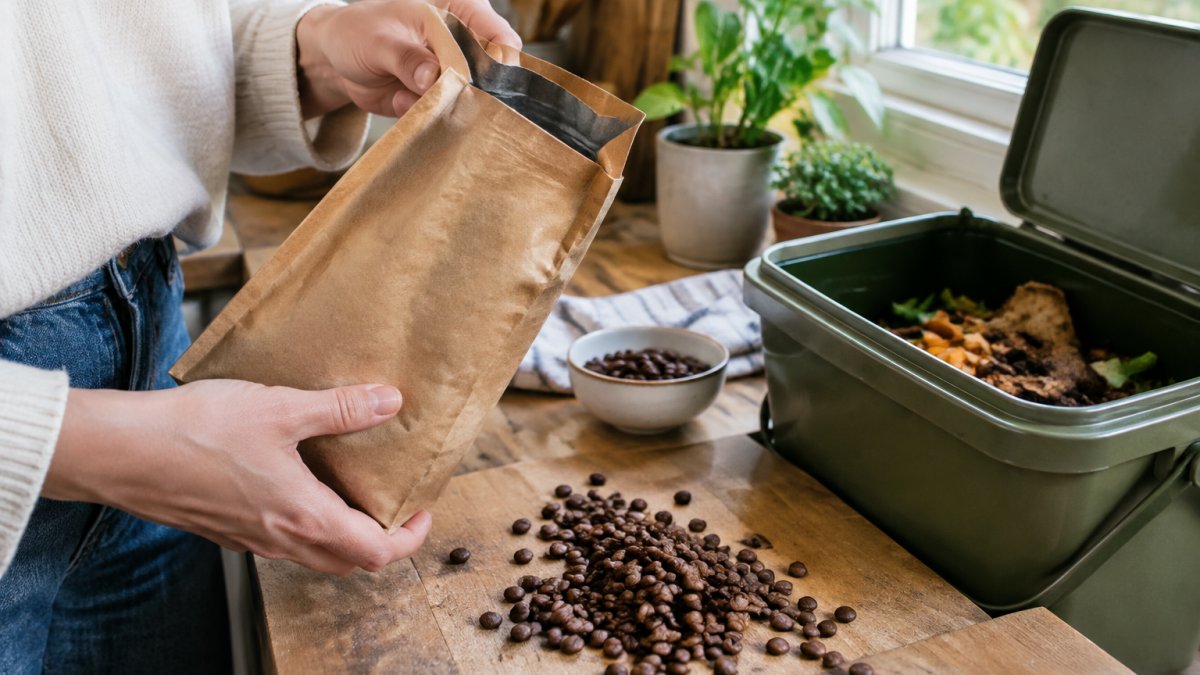
The certification marks that actually mean something
Look for a home-compostable certification mark on the bag, and check the certification standard named on it. A bag certified only for industrial composting belongs in your council's food and garden organics collection, not your garden. Recyclable soft plastic is a separate claim again: it needs a kerbside or drop-off pathway to be true, and most curbside recycling does not accept soft plastics. If a bag says "biodegradable" with no standard number, treat it as general waste.
What to do with the bag, the valve and the tin tie
A compostable bag is only compostable if you remove the non-compostable fittings first. The one-way degassing valve and the tin tie are usually plastic or metal and should be pulled off before the bag goes into the compost. Cut the bag open along the seam to speed up breakdown, and tear it into smaller pieces. A common pattern is that home composters overload the bin with whole bags and then wonder why nothing breaks down; a shredded bag in a balanced bin with browns and greens will disappear over a few months. If you are not composting, check whether your council accepts certified compostable packaging in the organics bin, many do, but the rules differ by council.
The grounds are the bigger waste stream
Spent coffee grounds are the part of a subscription most guides ignore. They are close to neutral once composted and are a useful nitrogen source, but only in moderation: a thick layer of wet grounds can mat and go anaerobic. Spread them thin, mix them through, or add them to a worm farm in small amounts.
Consumer sentiment is split. Mono-material recyclable and compostable formats are gaining ground across the industry, and for a deeper look at the formats available, read our guide to environmentally friendly coffee bean packaging.
Watch out: a bag that says "biodegradable" but carries no home-compost certification usually belongs in general waste, where it behaves like soft plastic.
Choosing the Right Coffee Subscription Delivery Frequency
Delivery frequency should match how fast you actually drink coffee, not how often a roaster wants to bill you. Consumption varies with brew method and how many people are drinking.
Fortnightly, monthly or flexible pause
Fortnightly delivery suits espresso drinkers pulling two or more shots a day. Monthly delivery suits filter and pour over brewers, or anyone drinking a single cup most mornings. Flexible pause is the feature to test before you commit: a subscription that lets you skip a delivery during a holiday or a busy fortnight is worth more than a small discount.
Roast date matters more than delivery speed, which is why the roast date should be printed on the bag. If a roaster cannot tell you when the beans were roasted, the frequency question is moot.
Why a Specialty Coffee Subscription Beats Supermarket Beans
Specialty coffee is graded coffee that scores highly on cupping evaluation, and a specialty coffee subscription beats supermarket beans on freshness and traceability. Supermarket stock can sit on shelves for a long time, while specialty roasters typically print the roast date.
The Australian market is shifting this way. Premiumisation is driving growth in specialty coffee, with consumers demanding high-quality, ethically sourced beans, according to Source Ready's 2026 specialty coffee analysis. If you are moving away from supermarket bags, our guide on how to identify specialty grade coffee beans explains what to look for on the label.
Cost Per Cup: Comparing Value Across Sustainable Subscriptions
Cost per cup is a more useful comparison than bag price, because bag prices hide how far the coffee actually stretches. The maths is simple: divide the bag price by the number of doses it yields, then add the cost of milk, filter papers or pods if you use them. What changes the answer is dose size and brew method, not the headline bag price.
A cost-per-cup table you can actually use
Dose size is the variable most people miss. The table below uses a $18.00 bag and typical doses; adjust the dose column to match your own scales.
| Brew method | Typical dose | Cups per 250g bag | Cost per cup at $18.00 |
|---|---|---|---|
| Espresso (double shot) | 20g | 12 | $1.50 |
| Moka pot | 15g | 16 | $1.13 |
| Pour over / V60 | 15g | 16 | $1.13 |
| Plunger / French press | 30g per 500ml | 8 | $2.25 |
| Cold brew concentrate | 60g per litre | 4 | $4.50 |
Cups per 250g bag
Two things fall out of that table. First, espresso is not automatically the cheapest cup, a double shot uses more coffee than a pour over, so the per-cup figure is higher even though the ritual feels cheaper than a cafe. Second, cold brew looks expensive per cup but yields a concentrate you dilute, so the real figure is closer to the pour over line once you account for the water you add.
The cafe comparison, done properly
Three coffees a day from a cafe at $5 each costs about $5,475 a year. The same habit brewed at home lands in the hundreds: at $1.13 a cup for pour over, three cups a day is roughly $1,237 a year before milk, and at $1.50 a cup for espresso it is about $1,642. The gap is the equipment and the milk, not the beans, a home espresso machine and grinder pay for themselves over a year or two at that rate, which is why the cost-per-cup figure matters more than the bag price on the shelf.
What the price does not show
Value also includes what the purchase supports. The charitable blends donate 10% of profit to their partner organisations, so part of your spend goes somewhere specific. And a subscription that lets you pause or skip avoids the hidden cost of stale beans you never drink, a bag you throw out is the most expensive cup of all. If you want to try before committing, the Sample Pack lets you test the range at low commitment.
Matching Your Subscription to Your Brew Method
Brew method compatibility is where most buying guides stop short. Espresso needs a roast developed for pressure and milk; filter and pour over need a roast that lets acidity and clarity show through.
The Harmony, Shelter, Symphonic and Hush blends are roasted for espresso, with a stated recipe of 20g dose, 32g yield, 92C water and a 27 to 30 second shot. If you brew filter or pour over, browse our filter roasts instead.
Sustainability in coffee is a chain, not a sticker, and the weakest link is usually the one nobody checks. We built Garage Roasters around verifiable choices: fully compostable packaging, grade 1 beans, and a scientific roasting method refined over thousands of research roasts.
Frequently Asked Questions
What makes a coffee subscription sustainable?
A sustainable coffee subscription combines ethically sourced beans with low-impact packaging and transparent delivery. Look for traceable single origin or direct trade sourcing, a roast date printed on the bag, and packaging that is certified compostable or recyclable. Delivery frequency matters too: a schedule you can pause or adjust prevents wasted beans. Garage Roasters uses fully compostable packaging.
How much does a sustainable coffee subscription cost?
Garage Roasters sells its blends at $18.00 per bag. Compare cost-per-cup rather than bag price: a cheaper bag that forces you to grind coarser or waste stale beans often costs more over a month. Factor in shipping and how often you actually drink coffee before committing.
Can I pause or cancel a coffee subscription?
Reputable roasters offer flexible pause and cancel options, often with no lock-in contract. Check the terms before subscribing: some services auto-renew on a fixed cycle, while others let you skip a delivery or change frequency at any time. If you travel or drink less in summer, a flexible pause stops beans piling up and going stale, which is itself a sustainability win.
Are coffee subscriptions better for the environment than buying coffee in shops?
Subscriptions can reduce waste because beans are shipped in regular deliveries rather than sitting on a shelf. The trade-off is shipping emissions, which depend on distance and consolidation. A subscription that roasts weekly and uses compostable packaging typically beats single-serve pods and stale supermarket stock. Buying from a local roastery direct shortens the supply chain further.
What should I look for in sustainable coffee packaging?
Check for a specific claim rather than a vague one: certified compostable, home compostable, or recyclable mono-material. Look for the certification body named on the bag, and confirm whether it breaks down in a home compost bin or needs commercial processing. Garage Roasters uses fully compostable packaging.
