
Table of Contents
- Why Environmentally Friendly Coffee Bean Packaging Matters
- Understanding Compostable Coffee Bags
- Home Compostable Coffee Packaging: What Works
- Recyclable Coffee Bags and Local Infrastructure
-
Coffee Packaging Freshness: Balancing Protection with Sustainability
- How coffee degrades and what packaging must block
- Barrier performance: conventional plastic versus eco-friendly alternatives
- Translating barrier specs into real shelf life
- How to test and verify shelf life for your specific packaging
- Degassing valves and their role in sustainable packaging
- Storage and handling: extending shelf life beyond packaging specs
-
How to Choose the Right Packaging for Your Needs
- Step 1: Map your local disposal infrastructure and verify acceptance
- Step 2: Verify certifications and cross-check supplier claims
- Step 3: Assess freshness requirements and barrier performance
- Step 4: Compare total cost, minimum orders, and supplier lead times
- Step 5: Test with a pilot batch before scaling
- Reusable and Refill Systems in Practice
- Frequently Asked Questions
Last Updated: October 11, 2026
Why Environmentally Friendly Coffee Bean Packaging Matters
Coffee packaging affects freshness, environmental impact, and whether your daily brew aligns with your values. The right choice preserves bean quality whilst reducing environmental harm.
Understanding Compostable Coffee Bags
Compostable coffee bags break down into natural materials under specific conditions, but only if you have access to the right composting system.
Compostable bags are made from plant-based materials like PLA or wood pulp blends. They break down only in industrial composting facilities at 58°C+; home compost heaps rarely get hot enough.
Industrial versus home compostable certifications
Industrial compostable bags carry certifications like AS 5810, guaranteeing breakdown within 180 days. Home compostable bags are rarer and require specific conditions. Industrial compostable is more common because most councils operate industrial composting facilities.
Certification is enforceable; bags labelled "biodegradable" without certification may take years to break down or leave microplastics behind.
Home Compostable Coffee Packaging: What Works
Home compostable coffee packaging is uncommon because home compost doesn't reach industrial temperatures. The process takes 6-12 months in an active heap. Paper-based bags with plant-based linings are best, though they offer less protection. For most home drinkers, industrial compostable bags are more practical if your council collects them in green waste.
Recyclable Coffee Bags and Local Infrastructure
Recyclable bags are only useful if your local recycling system accepts them.
Contact your council before choosing recyclable packaging: do they accept soft plastic in kerbside collection or require drop-off? If neither applies, a recyclable bag becomes a landfill bag.
Recyclable bags are made from plastic film with aluminium barriers. Bonded barrier layers make separation difficult; single-layer bags recycle more easily.
Paper bags with plastic or foil linings often contaminate recycling streams. Check local guidelines before choosing this option.
Coffee Packaging Freshness: Balancing Protection with Sustainability
Sustainability and freshness create real trade-offs. Eco-friendly materials sacrifice some barrier protection compared to conventional plastic, but the trade-off is acceptable for most use cases.
How coffee degrades and what packaging must block
Fresh roasted coffee is chemically unstable. Beans release CO₂ within hours, oils oxidise with oxygen exposure, moisture accelerates staling, and light breaks down flavour compounds.
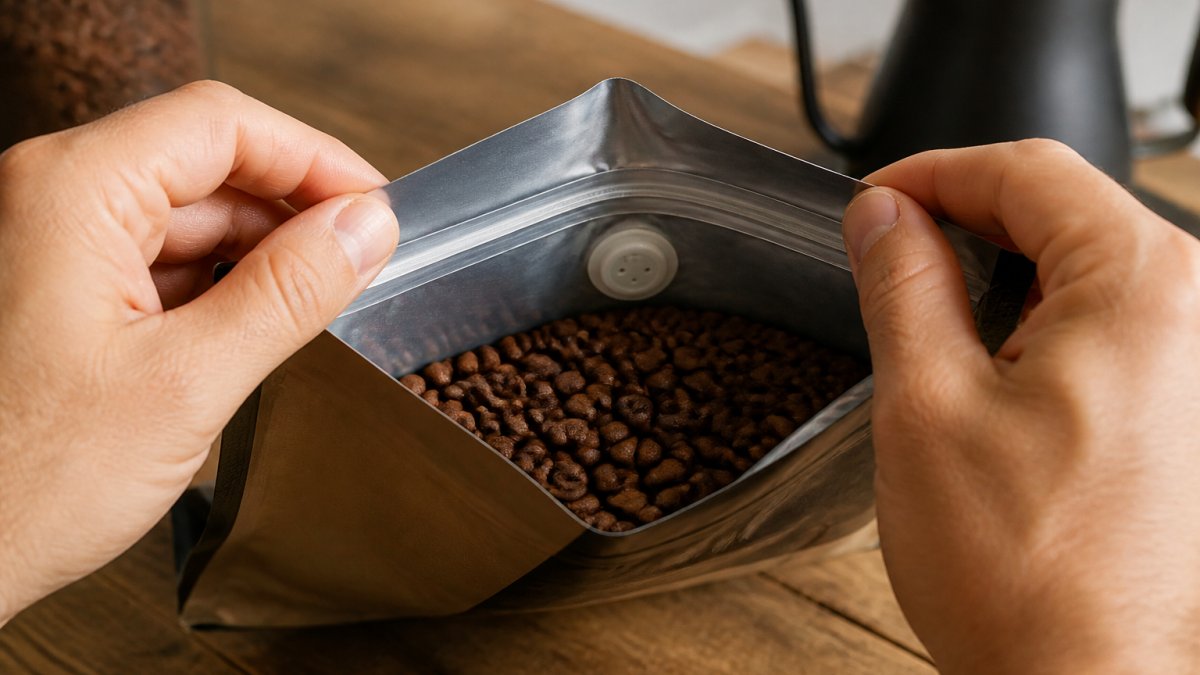
A coffee bag must: (1) block oxygen (OTR in cc/m²/day; lower is better), (2) block moisture (WVTR in g/m²/day; lower is better), (3) block light, and (4) allow CO₂ escape via one-way degassing valve.
Barrier performance: conventional plastic versus eco-friendly alternatives
Typical barrier specifications for common packaging materials:
Conventional multilayer plastic: OTR 5-15 cc/m²/day, WVTR 2-5 g/m²/day, 12-18 month shelf life, AUD $0.15-0.25 per unit.
Compostable bags: OTR 20-50 cc/m²/day, WVTR 5-15 g/m²/day, 6-10 week shelf life, AUD $0.20-0.35 per unit (20-40% premium).
Recyclable soft plastic: OTR 10-25 cc/m²/day, WVTR 3-8 g/m²/day, 8-14 week shelf life, AUD $0.18-0.28 per unit.
Paper bags with lining: OTR 50-150 cc/m²/day, WVTR 15-40 g/m²/day, 4-8 week shelf life, AUD $0.22-0.32 per unit.
Rigid containers: OTR 0-5 cc/m²/day, WVTR 0-2 g/m²/day, 18+ month shelf life, AUD $0.30-0.60 per unit.
Translating barrier specs into real shelf life
For 6-8 week freshness (home use): Compostable bags with OTR 20-50 cc/m²/day are acceptable.
Purchase Garage Roasters coffee here! →
For 10-12 week freshness (home enthusiast, small retail): Compostable bags are marginal. Recyclable bags with foil lining or conventional plastic are safer.
For 14-16 week freshness (wholesale, mail order): Compostable bags are unsuitable. Recyclable bags with foil lining or conventional plastic are necessary.
How to test and verify shelf life for your specific packaging
Run a simple freshness test:
- Establish a baseline: Package beans in current and new eco-friendly packaging; seal immediately after roasting.
- Store under standard conditions: Keep both at room temperature (20-22°C), away from direct light, for 12 weeks.
- Taste at intervals: Open and taste at weeks 2, 4, 6, 8, 10, and 12 using the same brewing method.
- Note degradation: Track oxidation flavours (cardboard, papery), staling (dull, lifeless), or off-flavours (rancid, musty).
- Compare cost-benefit: If freshness is acceptable, the cost premium is justified. If not, upgrade to higher-barrier material or rotate stock faster.
Degassing valves and their role in sustainable packaging
One-way degassing valves are critical for fresh-roasted coffee and compatible with all sustainable packaging materials. The valve allows CO₂ to escape for 3-7 days after roasting without allowing oxygen to enter. Confirm with your supplier that the valve is made from materials compatible with your chosen packaging (e.g., compostable valve for compostable bags), rated for your roast profile's CO₂ volume, and installed correctly. Some cheaper compostable bags use conventional plastic valves, which contaminates the compostable stream.
Storage and handling: extending shelf life beyond packaging specs
Packaging specs assume room-temperature storage. You can extend shelf life by controlling storage conditions:
- Temperature: Every 5°C increase in storage temperature roughly halves shelf life. Store at 15-18°C if possible; avoid warm kitchens or direct sunlight.
- Humidity: Keep relative humidity below 60%. High humidity accelerates moisture ingress and staling, especially in compostable and paper bags.
- Light: Store in a dark cupboard or opaque container. Light exposure accelerates degradation regardless of bag opacity.
- Seal integrity: Reseal bags after opening. Many eco-friendly bags have weaker seals than conventional plastic; use a clip or transfer beans to an airtight container after opening.
These practices are especially important for compostable bags, which have higher WVTR and are more sensitive to environmental conditions.
How to Choose the Right Packaging for Your Needs
Choosing packaging means matching your situation to what actually works where you live, then stress-testing that choice against cost, supply constraints, and freshness needs before committing to thousands of units.
Step 1: Map your local disposal infrastructure and verify acceptance
Contact your council's waste management team and ask: Do you accept AS 5810 certified compostable bags in green waste? Do you collect soft plastic in kerbside recycling or require drop-off? Can you process paper bags with plastic or foil linings? What plastic types do you accept? Write down the answers verbatim; the waste team's direct answer is the only reliable source.
Step 2: Verify certifications and cross-check supplier claims
For compostable packaging, look for certifications like AS 5810 (Australian standard; guarantees breakdown within 180 days at ≥58°C) or EN 13432 (European standard). Don't accept vague claims like "eco-friendly" or "biodegradable" without a certification standard and test report. For recyclable bags, cross-reference the material code against your council's accepted list; soft plastic (LDPE #4 or mixed film) clogs many sorting machines.
Step 3: Assess freshness requirements and barrier performance
Define how long your beans need to stay fresh and at what quality level:
- Home use, casual drinker: 6-8 weeks acceptable; slight flavour fade tolerable
- Home use, specialty enthusiast: 8-12 weeks preferred; minimal oxidation required
- Retail or café display: 12-16 weeks minimum; beans must look and taste fresh at point of sale
- Wholesale or mail order: 16+ weeks; long supply chain and customer storage time
Ask your supplier for: (1) Oxygen transmission rate (OTR) in cc/m²/day (lower is better; typical ranges: conventional plastic 5-15, compostable 20-50, paper 100+), (2) Water vapour transmission rate (WVTR) in g/m²/day (lower is better; typical ranges: conventional 2-5, compostable 5-15, paper 20+), and (3) Degassing valve type (one-way valves are standard and don't affect compostability). If your freshness requirement is 12+ weeks and the compostable bag has OTR 40+ cc/m²/day, it won't meet your needs; shift to a recyclable option or accept shorter shelf life.
Step 4: Compare total cost, minimum orders, and supplier lead times
Typical price ranges (per 100 units, custom printed): conventional plastic AUD $15-25, compostable AUD $20-35, recyclable soft plastic AUD $18-28, paper with lining AUD $22-32, reusable containers AUD $30-60. Minimum orders: stock designs 500-1,000 units, custom printing 2,000-5,000 units, complex designs 5,000-10,000 units. A 5,000-unit order locks you in for 3-6 months; test with smaller quantities first. Ask suppliers about lead time (compostable bags often take 4-6 weeks vs. 2-3 weeks for conventional), storage requirements, and reorder flexibility.
Step 5: Test with a pilot batch before scaling
Order a small quantity (500-1,000 units) and run a real-world test: store beans under normal conditions and taste at weeks 4, 8, and 12 compared to current packaging; attempt to dispose of bags according to council instructions; ask customers about ease of opening, seal resealing, labelling clarity, and disposal knowledge. Use this data to refine your choice: if freshness is worse, upgrade to higher-barrier material; if disposal is problematic, switch to a material your council accepts; if cost is unsustainable, explore reusable systems.
Reusable and Refill Systems in Practice
Reusable bags and refill programs eliminate packaging waste at the point of sale. The challenge is logistics: reusable bags need cleaning, tracking, and return infrastructure. Refill programs work best for local, repeat customers (e.g., a café where regulars visit weekly).
Choosing environmentally friendly coffee bean packaging means understanding what happens to your bags after you use them. The most sustainable choice isn't the one with the greenest marketing, it's the one your local infrastructure can actually process.
Frequently Asked Questions
Is compostable coffee packaging actually effective at keeping beans fresh?
Compostable bags can protect coffee freshness if they include proper barriers against oxygen, moisture, and light. Look for bags with aluminium or plant-based barrier layers and a degassing valve. Industrial compostable bags often perform as well as conventional plastic for freshness preservation. Home compostable bags may offer slightly less protection, so check the supplier's shelf-life claims. Freshness depends on the barrier quality, not the material's end-of-life disposal method.
What's the difference between home compostable and industrial compostable coffee packaging?
Industrial compostable bags break down in commercial composting facilities (50-60°C, 12 weeks) and are certified to AS 5810. Home compostable bags decompose in home compost bins (20-30°C, 12 months) and carry AS 5810 home compostable certification. Industrial bags are more widely accepted by council collection programs. Home compostable bags suit customers with active compost systems but may not break down in standard home conditions. Both can preserve coffee freshness equally well if barriers are adequate.
Can coffee bean bags be recycled in my local council program?
Most soft plastic coffee bags are not accepted in standard kerbside recycling, even if marked recyclable. Check your local council's guidelines, many accept flexible packaging only through dedicated soft plastic collection programs at supermarkets or specialist drop-off points. Paper-based bags with plastic liners face similar barriers. Verify your local infrastructure before choosing recyclable packaging, as disposal options vary significantly by region. Some councils now accept soft plastics, so confirm current rules with your provider.
How do I know if a coffee bag's compostability claim is genuine?
Look for certification logos from accredited bodies like Australian Certified Organic or third-party verifiers that reference AS 5810 (industrial) or AS 5810 home compostable standards. Genuine certifications appear on the packaging and are verifiable through the certifier's database. Marketing terms like 'eco-friendly' or 'plant-based' without certification are not proof. Ask suppliers for their certification documents. Certified bags cost slightly more but guarantee the material will actually decompose in the conditions claimed.