
Last Updated: November 3, 2026
Quick Summary
Sour specialty coffee is almost always an extraction problem, not a bean problem, because sourness is a perception threshold rather than a fixed property of the bean. Grind finer in small steps, raise brew temperature slightly, tighten the ratio and check your water alkalinity before blaming the roast.
- Sourness hits the sides of the tongue with an abrupt, drying finish and no sweetness.
- Grind finer one notch at a time, since stepless grinders make small steps easier.
- Grinding too fine to fix sourness pushes you into channeling and a sour-bitter cup.
- Low-alkalinity water lets acidity run unchecked and is a prime suspect for sourness.
- Change one variable per shot so you know which adjustment actually worked.
Table of Contents
- Why Sour Specialty Coffee Happens Before You Change Anything
- Spotting Under-Extracted Coffee by Eye and by Taste
- Coffee Grind Size for Espresso: The First Dial You Should Turn
- Water Temperature, Brew Ratio and Contact Time
- Sour vs Bitter Coffee: Telling the Two Faults Apart
- Water Chemistry and Roast Profile: The Angles Most Guides Skip
- How to Fix Sour Coffee: A Step-by-Step Troubleshooting Sequence
- Order Beans That Hold Their Extraction
- Frequently Asked Questions
Why Sour Specialty Coffee Happens Before You Change Anything
Sour specialty coffee usually isn't a bean problem. It's an extraction problem, and it starts long before you touch the grind dial. When a shot tastes sharp and thin, most drinkers assume the roast is too light or the beans are bad. The puck is often telling you something more specific.
Researchers at the University of Southern Denmark's coffee science programme examined the acid composition of specialty coffee and mapped the sensory thresholds where those acids register as sour on the palate. Their finding matters: sourness is a perception threshold, not a fixed property of the bean. Push extraction far enough and the same acids read as bright and pleasant. Pull it short and they read as harsh.
That's the core tension in this whole topic. Acidity is the point of specialty coffee. Sourness is what happens when you fail to extract it properly.
Positive acidity versus a sour fault
Positive acidity tastes like citrus, stone fruit or red apple. It sits inside a sweet, balanced cup and gives it life. The Specialty Coffee Association's guidance on flavour and sweetness notes that sweetness correlates with fruity and fermented profiles, and that imbalance masks it.
A sour fault is different. It hits the sides of your tongue, finishes abruptly, and leaves a drying, tangy edge. No sweetness follows it. That gap, between bright and tangy, is the whole diagnosis.
Spotting Under-Extracted Coffee by Eye and by Taste
Under-extracted coffee shows up on the palate first and in the cup second. Taste is the reliable signal; visuals confirm it. Here's what to look for before you change a single setting.
- Taste: sharp acidity up front, thin body, almost no sweetness, a fast finish
- Mouthfeel: watery rather than syrupy, with no coating on the tongue
- Colour: espresso that runs pale blond from early in the shot, not deep hazelnut
- Puck: soggy on top, crumbly, sometimes with visible channels bored through it
- Flow: the shot races out, blonding within the first few seconds
The visual cues are the ones most guides skip. Watch the stream, not just the timer. A shot that turns blond at eight seconds is telling you the water found a path of least resistance through the puck.
That's channeling, and it's a form of under-extraction that no grind adjustment fixes on its own.
Coffee Grind Size for Espresso: The First Dial You Should Turn
Grind size is the single biggest lever on extraction, and it's where we'd start every time. Finer grinds expose more surface area to water, which pulls more solubles out of the puck. Coarser grinds do the opposite.
If your coffee tastes sour, grind finer in small steps and pull another shot. One notch at a time, not five. Stepless grinders make this easier because you're not locked to fixed clicks.
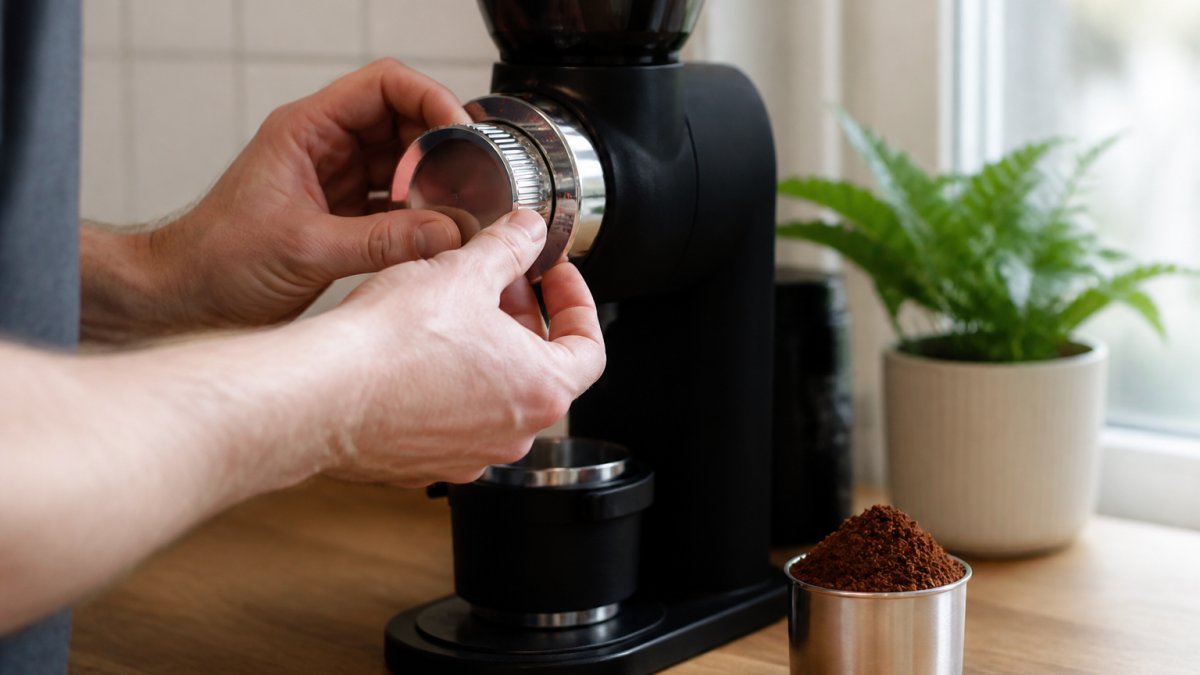
A Turin DF54 V4 Single Dose Grinder gives you stepless adjustment and well-aligned 54 mm burrs out of the box, which matters here. If your grinder can't hold a setting between shots, you'll chase sourness forever.

Watch out: grinding too fine to fix sourness pushes you straight into channeling, where water punches through cracks in the puck and leaves you sour and bitter at once. If the shot slows to a drip and still tastes sharp, back off and look at your distribution instead.
Water Temperature, Brew Ratio and Contact Time
Temperature, ratio and time work as a set. Water that's too cool can't dissolve the compounds that carry sweetness. Too little coffee relative to water dilutes what does extract. Too short a contact time stops the process early.
Brew ratio is the weight of coffee against the weight of water. A tighter ratio, more coffee to less water, concentrates the cup and can mask thinness. A looser one exposes it.
Contact time is how long water meets coffee. For espresso, that's the shot duration. For pour-over, it's the whole brew.
Bump temperature up a couple of degrees and lengthen the shot slightly. Both changes push extraction further. Do them one at a time so you know which one worked.
Sour vs Bitter Coffee: Telling the Two Faults Apart
Sour and bitter sit at opposite ends of the extraction spectrum, and confusing them sends you the wrong way. Sour means under-extracted. Bitter means over-extracted. Fixing one by adjusting the other direction makes the fault worse.
Here's the quick comparison:
Fellow Opus 2 Conical Burr Grinder - Black →
| Signal | Sour (under-extracted) | Bitter (over-extracted) |
|---|---|---|
| Where it hits | Sides of the tongue | Back of the palate |
| Finish | Abrupt, drying, tangy | Long, ashy, lingering |
| Sweetness | Missing or faint | Buried under harshness |
| Body | Thin, watery | Heavy, sometimes gritty |
| Shot flow | Fast, early blonding | Slow, dark and syrupy |
| Fix direction | Grind finer, extract more | Grind coarser, extract less |
Bitterness comes from over-extraction and, in darker roast profiles, from the roast itself. Tannins and harsh compounds build up when water keeps working on the puck too long.
If you're genuinely unsure which fault you're tasting, a flavour wheel reference helps you name what's in the cup rather than guessing.
Water Chemistry and Roast Profile: The Angles Most Guides Skip
Water chemistry is the gap in almost every sour-coffee guide, and it is often the real culprit. Two numbers matter: total dissolved solids and alkalinity. Water mineral content matters for extraction, and it can explain why the same beans taste bright in one kitchen and dull in another.
Total dissolved solids is the mineral content of your water. Too little and the water is flat and extracts poorly, because there are few minerals to help pull solubles from the grounds. Too much and it tastes chalky and mutes flavour, coating the palate so the acidity never lands cleanly.
Alkalinity is the water's ability to buffer acids, and this is the number most drinkers never check. High-alkalinity water neutralises the very acids that give specialty coffee its brightness, so the cup tastes flat and dull rather than sour. Low-alkalinity water lets acidity run unchecked, which is where a bright cup tips into a sharp, sour edge.
The practical test is cheap. Buy a drop-style aquarium test kit for carbonate hardness and general hardness, or a brewing-specific water test, and measure your tap water before you change another grinder setting. If alkalinity reads very low, a small addition of a brewing mineral sachet or a switch to a low-mineral bottled water with a known profile will often settle the cup.
Watch out: chasing water chemistry with home-made salt additions before you have measured your starting water is how people end up with chalky, undrinkable brews and no idea which variable caused it.
Roast profile matters just as much. Third-wave specialty roasts lighter to showcase origin character, per industry analysis of light-roast trends, and those citrus and floral notes can tip into sourness if extraction isn't dialled in.
Some shops even under-extract on purpose to push sharp acidity. That's a deliberate style choice, and it's not what you want in your kitchen.
How to Fix Sour Coffee: A Step-by-Step Troubleshooting Sequence
Work through these in order and change one variable per shot. Changing three things at once tells you nothing.
- Taste and name the fault. Sour or bitter? Confirm before touching anything.
- Check your water. If alkalinity is very low, your acidity has nothing holding it in check.
- Grind finer, one small step. Pull a shot and taste.
- Raise brew temperature slightly. Two degrees at a time.
- Tighten the ratio. A little more coffee, a little less water.
- Lengthen contact time. A few seconds more on the shot.
- Check puck prep. Level the bed, distribute evenly, tamp straight. Channeling mimics under-extraction.
- Check freshness. Very fresh beans degas heavily and behave unpredictably. Stale beans taste flat and papery.
- Reassess the roast. A very light roast may simply need more extraction than your setup delivers.
If you want the full walkthrough for step three, our guide on how to dial in home espresso takes you through it systematically.
Order Beans That Hold Their Extraction
Beans that extract consistently remove half the guesswork. A stable roast means the same settings work tomorrow that worked today, which is exactly what most home baristas are chasing.
This is where we'd point you to what we do at Garage Roasters. Garage Roasters is run by a scientist using a methodical, research-based process refined over thousands of research roasts, built around consistency rather than daily tweaking. We specialise in top-grade African and Colombian single origins, packed in fully compostable packaging.
If your shots drift day to day, our piece on why espresso tastes different every day explains the variables before you blame the beans.
Ready to remove the variable entirely? Browse our espresso roasts and start with beans built to hold their extraction.
Frequently Asked Questions
Why does sour specialty coffee happen even when I follow the roaster's recipe?
A printed recipe is a starting point, not a guarantee. Sourness usually means the water has not pulled enough soluble material out of the grounds, which happens when the grind is too coarse, the dose is too high for the basket, the temperature is low, or the shot runs too fast. Light roasts make this more likely because they are denser and less soluble, so the same recipe that worked on a darker bean can taste sharp on a light single origin. Adjust one variable at a time and taste after each change.
Is sour coffee always under-extracted coffee?
Most of the time, yes. Under-extraction leaves acids in the cup before sweetness and body have developed, so the result reads as tangy or thin. But two other causes exist. Very light roast profiles carry genuine citrus and stone fruit acidity that is meant to be there, and water with high alkalinity or unusual mineral content can push perception either way. If the cup tastes bright but sweet and rounded, that is acidity working as intended. If it tastes sharp and hollow, treat it as under-extraction.
How do I tell sour vs bitter coffee apart when I am dialling in?
Sourness hits the sides of your tongue and the back of your jaw, and it finishes clean and dry. Bitterness sits on the back of the tongue, lingers, and often comes with an ashy or drying finish. The fix runs in opposite directions: sour coffee needs more extraction, so grind finer, raise the temperature slightly, or extend the shot. Bitter coffee needs less, so grind coarser or shorten the shot. Chasing the wrong fault doubles the problem, so taste deliberately before you touch the grinder.
Will a better grinder actually fix sour espresso?
It can help with one common cause. Sour shots often come from an uneven grind, where fine particles over-extract and coarse particles under-extract in the same puck, leaving you with sourness and harshness together. A grinder with aligned burrs and stepless adjustment lets you move in small, repeatable steps. The Fellow Opus 2 at $386.00 uses 48 mm conical burrs with a stepless dial, and the Turin DF54 V4 at $417.00 pairs 54 mm flat burrs with retention under 0.1 gram, so the dose you weigh is the dose you brew.
Sour shots are solvable, but only if you stop guessing and start isolating variables. Garage Roasters roasts for consistency so your dial-in holds from one morning to the next, with single-origin beans, a scientific roasting process, and compostable packaging. Get started with Garage Roasters and pull a shot that tastes the same tomorrow as it does today.
