
Table of Contents
- What Specialty Coffee Quality Actually Means
- Can Basic Machines Brew Specialty Coffee? The Direct Answer
- How to Make Specialty Coffee at Home with Basic Equipment
- Coffee Brewing Methods Compared: Basic vs Specialty Equipment
- Coffee Grind Size for Different Brewing Methods
- How to Improve Pod Machine Coffee Quality
- Machine Limitations vs Variables You Control
- Budget-Based Equipment Recommendations
- Frequently Asked Questions
Last Updated: October 5, 2026
What Specialty Coffee Quality Actually Means
Specialty coffee isn't just a marketing term. It refers to beans that score 80 points or higher on the Specialty Coffee Association's 100-point scale, evaluated across factors like aroma, flavour, acidity, body, and finish.
The difference between specialty and commodity coffee starts in the farm. Specialty producers track elevation, harvest timing, and processing methods. They care about consistency because their reputation depends on it. When you buy specialty beans, you're buying traceability and intentionality, not just caffeine.
But here's the critical part: specialty coffee quality also depends on how you brew it. The finest beans will taste flat and bitter in a stale pod machine or under-extracted in a basic drip brewer. Conversely, can basic machines brew specialty coffee?
Can Basic Machines Brew Specialty Coffee? The Direct Answer
Yes, basic machines can brew specialty coffee, but with important limits. A basic espresso machine or pour-over setup can extract flavours from quality beans that rival café results. The catch is that basic equipment gives you less margin for error.
Specialty coffee extraction depends on four things: grind size, water temperature, brew time, and coffee-to-water ratio. Basic machines require you to dial these in manually. Expensive machines automate some of this work. Neither approach is inherently superior, it's about what you're willing to control.
The real question isn't whether your machine can brew specialty coffee. It's whether you can manage the variables consistently enough to taste the difference.
How to Make Specialty Coffee at Home with Basic Equipment
Making specialty coffee at home with basic gear is entirely achievable. You need three things: fresh beans, the right grind, and precision in your brewing routine.
Bean Selection and Freshness
Start with beans roasted within the last 2-4 weeks. Freshness is non-negotiable for specialty coffee. Older beans lose volatile compounds that carry flavour and aroma. Check the roast date on the bag, if it's not printed, ask the roaster.
Single-origin beans showcase the farm's characteristics more clearly than blends. A washed Kenyan will taste bright and fruity. A natural Ethiopian will taste floral and complex. Blends flatten these notes to create consistency, which is useful for espresso but less interesting for exploring specialty coffee flavours.
Our Pour Over, a washed Kenyan from Murang'a County, won a 2024 GoldenBean Australasia Bronze Medal for its white currants and mandarin notes. That specificity, that you can taste the origin, is what separates specialty coffee from generic beans.
Water Quality and Temperature
Water quality matters more than most home brewers realise. Chlorinated or mineral-heavy water masks flavour. If your tap water tastes off, use filtered water.
Temperature control is where basic machines show their limits. Specialty coffee extraction happens best between 90-96°C. Too cool, and you under-extract (weak, sour coffee). Too hot, and you over-extract (bitter, burnt taste). Basic machines often lack temperature stability, so you're relying on a kettle and a thermometer.
Our Ethiopian Single Origin Espresso is brewed at 92°C with a 28-31 second pull. That precision is achievable at home with a basic kettle and a simple thermometer.

Brewing Technique and Control
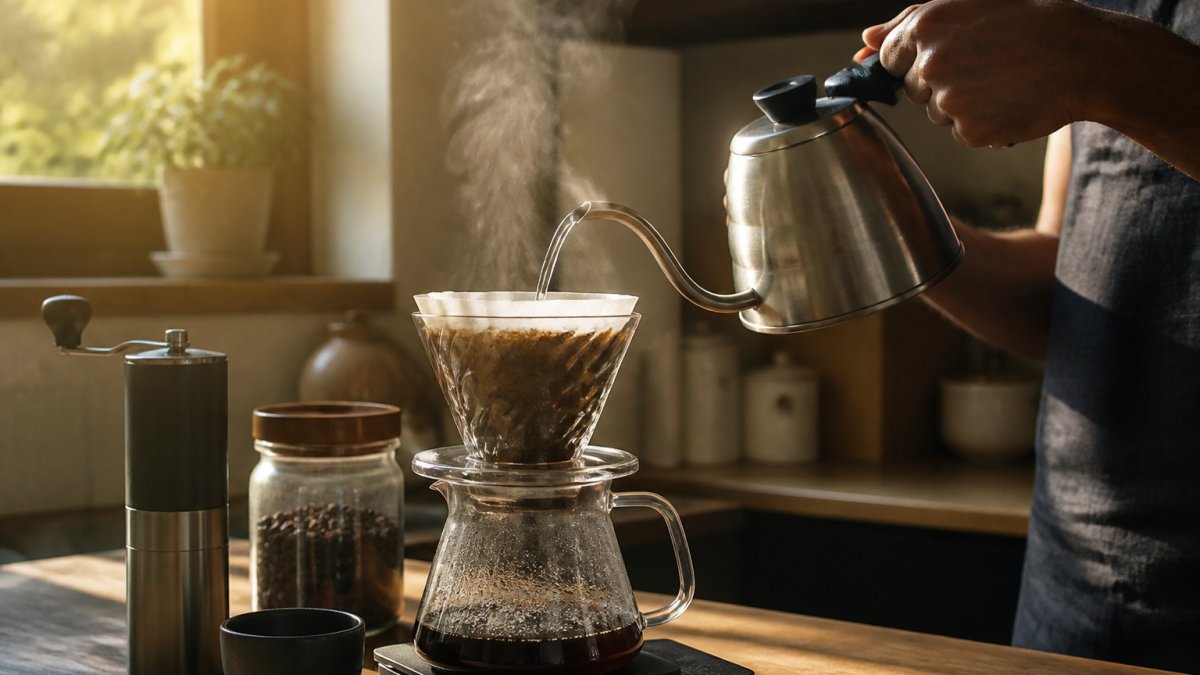
Technique separates specialty coffee brewers from casual coffee drinkers. With manual brewing methods, you control everything: how fast you pour, how long the water sits, how fine the grind is.
For pour-over, bloom the grounds with hot water for 30 seconds before pouring. This allows CO₂ to escape and water to reach all the coffee. Then pour slowly in circular motions. The entire brew should take about 3 minutes. Rushing it under-extracts. Dragging it over-extracts.
For French press, the grind must be coarse to avoid sediment, but coarse grinds extract slowly. A 4-minute steep is typical. Stir at the 2-minute mark to ensure even contact with water.
Basic machines give you control. That's actually an advantage if you're willing to pay attention.
Coffee Brewing Methods Compared: Basic vs Specialty Equipment
The gap between basic and specialty equipment is real, but it's narrower than marketing suggests. Here's where each wins.
Manual Brewing Methods
Manual methods, pour-over, French press, Moka pot, require hands-on work but give you complete control. You decide grind size, water temperature, and brew time. There's no automation hiding variables.
Pour-over is the gold standard for tasting specialty coffee. Water flows through the grounds once, extracting clean, bright flavours. It's slow (3-4 minutes) and requires focus, but the result is clarity. You taste the origin distinctly.
French press is forgiving and fast (4 minutes), but it produces a heavier body because fine particles stay in the cup.
Moka pots produce espresso-like shots without a pump. They're inexpensive and reliable, but pressure is limited to about 1-2 bars (espresso machines use 9 bars). The result is stronger than pour-over but less refined than true espresso.
Automatic Machines and Their Limitations
Basic automatic machines, pod brewers, automatic drip machines, remove variables. You add water and beans, press a button, and coffee appears. The downside: you've surrendered control over the things that matter most.
Pod machines are convenient but problematic for specialty coffee. The pods are sealed, so you can't adjust grind size.
Automatic drip machines lack temperature stability. Water temperature drops as it sits in the carafe. By the second cup, the coffee is cooling and flavours are fading.
Basic espresso machines (under $500) struggle with consistency. The grouphead cools between shots. Pressure fluctuates. Shot time varies.
High-end espresso machines like the Fellow Espresso Series 1 solve these problems with heated groupheads, stable boilers, and precise pressure profiling.

| Brewing Method | Equipment Cost | Control | Consistency | Best For |
|---|---|---|---|---|
| Pour-over | Under $30 | Full manual | High (if technique is solid) | Tasting specialty origins |
| French press | $20-$50 | Full manual | Medium (immersion brewing is forgiving) | Full-bodied beans |
| Moka pot | $30-$80 | Full manual | Medium (pressure varies with heat) | Strong, espresso-like shots |
| Pod machine | $100-$400 | None | Low (sealed pods, fixed extraction) | Convenience over quality |
| Basic espresso | $300-$800 | Partial (grind, dose, tamp) | Medium (inconsistent temperature) | Learning espresso basics |
| High-end espresso | $2,000+ | Full (pressure profiling, temperature) | High (stable across shots) | Consistent, repeatable results |
Coffee Grind Size for Different Brewing Methods
Grind size is the most controllable variable in home brewing, and it's where basic equipment shines.
Coarse grinds (like breadcrumbs) suit immersion brewing: French press, cold brew. Water contacts the coffee slowly, so you need time and surface area.
Medium grinds (like sand) suit pour-over and Moka pots. Water flows through at a moderate pace, extracting in 3-4 minutes.
Fine grinds (like powdered sugar) suit espresso. Water is forced through under pressure in 25-31 seconds.
The grinder matters more than the machine. A cheap blade grinder produces inconsistent particle sizes, which means uneven extraction. Some particles over-extract (bitter), others under-extract (sour).
Fellow Espresso Series 1 Coffee Machine - Black →
A burr grinder, either flat or conical burrs, produces uniform particles. At Garage Roasters, we stock the Turin DF54 and DF83 grinders because they deliver consistency at a fraction of the cost of premium brands.

For specialty coffee at home, a mid-range burr grinder ($300-$600) paired with a basic brewing method will outperform an expensive espresso machine paired with a cheap grinder.
How to Improve Pod Machine Coffee Quality
If you're using a pod machine, you're sacrificing some of what specialty coffee offers. But you can still improve the result.
First, choose better pods. Look for pods made with whole beans, not ground coffee that's been sitting in plastic. Some specialty roasters offer pod options. The freshness advantage is marginal, but it's something.
Second, understand your machine's limitations. Pod machines extract at a fixed time and temperature. You can't adjust these.
Third, use the pod immediately after insertion. Don't let it sit in the machine. The longer it sits, the more moisture it absorbs, which changes extraction.
None of this transforms a pod machine into a specialty coffee brewer. But it's the best you can do within those constraints.
Machine Limitations vs Variables You Control
Here's the honest assessment: machine limitations are real, but they matter less than you think if you control everything else.
Basic machines have these genuine limitations:
Temperature stability. Cheap espresso machines can't hold a steady temperature across multiple shots. This is a real problem for consistency.
Pressure consistency. Basic machines produce variable pressure, which means variable extraction. High-end machines maintain 9 bars consistently.
Milk steaming capability. Basic machines struggle to heat and steam milk simultaneously.
But here's what you control regardless of equipment price:
Grind size. A quality grinder works with any machine.
Water quality.
Freshness. Buy beans roasted within 2-4 weeks.
Brew ratio. Measure your coffee and water. The ratio (usually 1:16 to 1:18 for espresso, 1:15 to 1:17 for filter) is entirely in your hands.
Technique. Pour-over technique, tamping pressure, bloom time, these are free to learn and practise.
When you focus on what you control, basic machines become capable of producing genuinely good coffee. The machine is the least important variable.
Budget-Based Equipment Recommendations
Your budget determines what's realistic, not whether you can brew specialty coffee.
Under $200: Buy a pour-over dripper ($20-$40), a quality burr grinder ($100-$150), and a gooseneck kettle ($30-$50). This setup is entirely manual but capable of producing excellent specialty coffee.
$200-$600: Add an entry-level espresso machine ($300-$500) to your grinder and kettle setup. You'll need to learn tamping, distribution, and shot timing.
$600-$1,500: Upgrade to a better espresso machine with temperature stability and a mid-range grinder. Consistency improves noticeably.
$1,500+: The Fellow Espresso Series 1 at $2,448 is where automation genuinely helps. Heated grouphead, stable boiler, precise pressure profiling, and assisted milk steaming mean fewer variables to manage.
But none of these price points determines whether you can brew specialty coffee. A $200 pour-over setup with our Ethiopian Single Origin Espresso or Pour Over beans will produce coffee that rivals a café.
Brewing specialty coffee at home is achievable with basic machines, it just requires precision and the right beans.
Frequently Asked Questions
What is the difference between regular coffee and specialty coffee?
Specialty coffee starts with higher-grade beans, typically scored 80 points or above by certified tasters, and emphasises traceability, freshness, and precise brewing. Regular coffee focuses on volume and consistency without the same attention to origin, roast quality, or extraction variables. Specialty coffee is roasted to highlight the bean's unique characteristics, floral notes, fruit acidity, chocolate undertones, rather than mask defects. The difference becomes apparent in flavour complexity, aroma, and how the coffee evolves from the first sip to the finish.
Can a basic coffee machine make specialty coffee?
Basic machines can produce specialty-quality coffee if three conditions are met: freshly roasted, high-grade beans; proper grind size matched to your brewing method; and consistent water temperature and brew time. The machine itself doesn't create specialty coffee, the beans and technique do. However, basic machines lack precise temperature control and pressure stability, which limits consistency and repeatability. You'll achieve better results with a grinder and manual brewing method than with a basic automatic machine, even using the same beans.
Which matters more for coffee quality: the machine or the beans?
Beans matter more than the machine. Premium, freshly roasted beans like Garage Roasters' single-origin Ethiopian or Kenyan pour-over will taste noticeably better than commodity beans in almost any machine. However, the machine determines your ceiling for consistency and control. A basic machine with excellent beans produces good coffee but with shot-to-shot variation; a quality machine with excellent beans produces repeatable specialty-quality coffee. Start with beans, then invest in equipment to maintain that quality.
Can a pod machine make good-quality coffee?
Pod machines can produce acceptable coffee but face inherent limitations for specialty-quality results. Pre-ground coffee in sealed pods loses freshness faster than whole beans, and you cannot adjust grind size, dose, or water temperature to optimise extraction. Water temperature often fluctuates, and pressure may be inconsistent. To improve pod machine results, use the freshest pods available, ensure your machine is clean and descaled, and brew at the correct temperature if your machine allows adjustment. For specialty coffee, manual brewing or a machine with temperature and pressure control will outperform pods.
What is the 15-15-15 coffee rule?
The 15-15-15 rule is a guideline for consistency: use beans roasted 15 days ago (within the optimal freshness window), grind them 15 seconds before brewing, and brew with water at 15 degrees below boiling (approximately 93-94°C for espresso). This framework emphasises freshness, minimal oxidation between grinding and brewing, and proper temperature control. While not a rigid formula, it highlights the three variables that most affect extraction and flavour in specialty coffee. Ethiopian Single Origin Espresso is best enjoyed 1-5 weeks post-roast.