
Last Updated: November 8, 2026
Quick Summary
A vertical coffee workflow is worth it if you switch coffees often or already weigh your doses, because it removes time, mess and uncertainty from each shot. It does not make better coffee by itself, and casual drinkers who brew a few times a week will not notice the difference.
- A vertical workflow stores, weighs and loads beans above the grinder so gravity carries each dose down.
- The full single-dose routine runs about 60 to 75 seconds from beans to a tamped puck.
- Timed dosing drifts because older beans grind faster than fresh ones and burr wear adds to it.
- With a hopper, every coffee switch means purging 18 to 20 g of the previous coffee.
- The Turin DF54 costs $417.00 and the DF83 Gen 2 costs $849.00, both listed under 0.1 gram retention.
Table of Contents
- What a Vertical Coffee Workflow Actually Changes
- Single Dosing vs Hopper Grinder: The Core Difference
- Single-Dose Grinder Workflow, Step by Step
- Single Dosing Espresso Pros and Cons
- Espresso Grinder Retention: Why It Decides Your Workflow
- Timed, Volumetric and Grind-by-Weight Dosing Compared
- Matching the Workflow to Your Household or Café
- Build Your Vertical Setup at Garage Roasters
- Frequently Asked Questions
What a Vertical Coffee Workflow Actually Changes
A vertical coffee workflow stores, weighs and loads beans above the grinder, so gravity carries each dose down through grinding and into the basket with minimal handling. At Garage Roasters, we think whether it is worth it depends on how much friction you tolerate every morning. The layout does not make better coffee by itself; it changes the number of decisions and movements between waking up and drinking.
The pitch is simple: beans live in a single-dose chute or small hopper directly above the burrs. You drop in a weighed dose, grind, and grounds land in a cup or basket below. Nothing travels sideways, nothing gets scooped twice, and there is one place to look when something goes wrong.
That matters because most home espresso frustration is a sequence problem, not a grinder problem. A common mistake is buying a bigger machine to fix inconsistency that actually comes from stale grounds in a chute or a dose that drifts by a gram or two each morning.
Before you spend anything, ask what you want removed: time, mess, or uncertainty. A vertical layout usually removes all three, but only for drinkers who make espresso often enough to notice.
Single Dosing vs Hopper Grinder: The Core Difference
Single dosing means you weigh the exact beans for one shot and grind only those. A hopper-fed grinder holds a reserve of beans and doses by time or volume from that supply. The core difference is where freshness and control live: in your scale, or in the hopper.
Single dosing gives you repeatability across coffees: pull a decaf for a guest, then a light single origin, without contamination. Hopper grinding gives you speed: press a button, the timer runs, grounds fall.
The trade-off is real. Hopper-fed grinding is faster per shot, but beans left in a hopper are exposed to air and light. Single dosing is slower per shot but every gram is fresh and every dose deliberate.
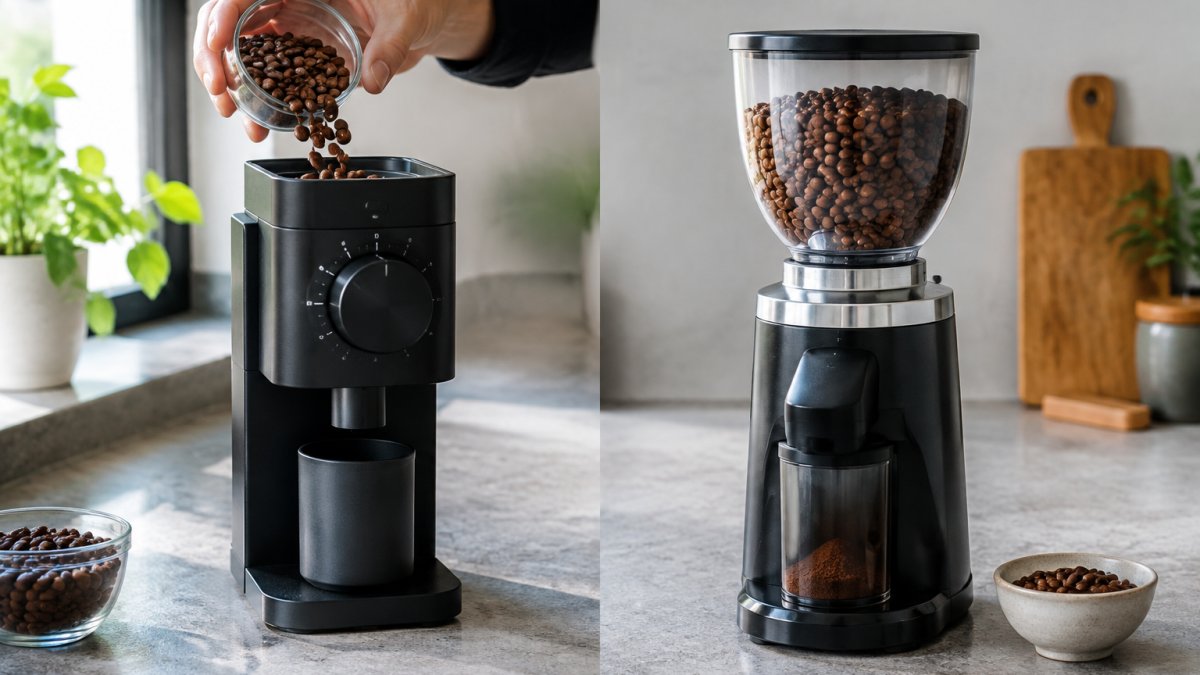
If you are still working out what single dosing means in practice, seeing an actual machine helps. The Turin DF54 V4 single dose grinder is built around this routine, with a 50 g bean chute and a dedicated dosing cup.

Single-Dose Grinder Workflow, Step by Step
Here is the full routine we would run, and roughly how long each stage takes once you are practised.
- Set the scale and cup. Place your dosing cup on a small scale and tare it. [Time: 10 seconds]
- Weigh the dose. Add beans to your target weight, usually 18 g for a double basket. [Time: 15 seconds]
- Load the chute. Tip the beans into the single-dose chute. [Time: 5 seconds]
- Grind. Start the grinder and let it run through the dose. [Time: 10-15 seconds]
- Bellow and settle. Give the bellows one or two presses to clear retained grounds. [Time: 5 seconds]
- Transfer and distribute. Tip the cup into the basket, then level and tamp. [Time: 20 seconds]
Call it 60 to 75 seconds from beans to a tamped puck, plus shot time.
The Turin DF83 Gen 2 single dose grinder uses 83 mm flat burrs and comes with a bellow and dosing cup.

Time for each step of the single-dose grinder workflow
Single Dosing Espresso Pros and Cons
Single dosing espresso lets you weigh each dose and switch beans without purging a hopper. It costs time per shot and asks you to weigh every dose rather than pressing a button.
The pros are concrete:
-
Dose accuracy. You know the weight going in, so you know what is coming out.
-
Bean switching. Decaf, a guest's coffee, a new single origin, all without purging a hopper.
The cons are just as real: it is slower, it demands a scale and the habit of using it. If you enjoy the ritual, that is a feature; if not, it becomes a chore by the second week.
Here is the part most guides skip: single dosing does not fix a bad dial-in. It gives you a repeatable starting point, but you still have to find the grind setting. Our guide on how to dial in home espresso walks through that process step by step.
Espresso Grinder Retention: Why It Decides Your Workflow
Grind retention is the weight of ground coffee left inside the grinder after a dose. It decides whether your workflow is predictable, because retained grounds come out in the next shot, stale and at a different grind setting if you have adjusted since.
This is the biggest argument for a vertical, single-dose layout. If a grinder holds a gram of old coffee in the chute and around the burrs, your 18 g dose becomes 17 g fresh plus 1 g of yesterday. The shot looks fine but tastes flatter, and you cannot work out why.
Some low-retention designs use a plasma generator in the exit chute and a bellows to reduce static and clear grounds. The Turin grinders we stock are listed with ultra-low retention of less than 0.1 gram.
For a deeper look at how burr size and geometry affect what stays behind, read our notes on grinder size and geometry.
Timed, Volumetric and Grind-by-Weight Dosing Compared
Three dosing systems dominate home espresso, and they differ in what they actually control. The table below is a starting point, but the mechanism behind each one is what determines whether it suits your workflow.
| Dosing method | What it controls | Accuracy | Best for |
|---|---|---|---|
| Timed dosing | Grind duration | Moderate, drifts with bean age and burr wear | Hopper setups, high volume |
| Volumetric dosing | Ground coffee volume | Moderate, affected by grind and freshness | Cafés with calibrated chambers |
| Grind-by-weight | Ground coffee mass | High, closes the loop on weight | Single dosing, precision routines |
Timed dosing is the simplest and most common on hopper grinders: set a time and the grinder runs that long. It drifts because older beans grind faster than fresh ones, and burr wear does the same slowly over months.
Volumetric dosing fills a chamber to a set volume. It is consistent in shape but not mass, because a finer grind packs more tightly. Two coffees at the same volume can differ by a gram or more.
Grind-by-weight measures output and stops at the target mass. It is the most accurate of the three and the natural partner to a vertical single-dose workflow, because the scale sits directly under the chute and the loop closes on the weight you want.
What this means for a vertical workflow. A vertical single-dose setup is not automatically grind-by-weight. Many single-dose grinders are timed or manual: you weigh beans in, grind for a set time, and trust the output. That works because the dose is fixed at the input, so output weight is predictable as long as retention is low.
Matching the Workflow to Your Household or Café
A vertical workflow suits some homes and some cafés, and it is overkill for others.
One drinker, one coffee. A hopper is convenient here. You fill it, press a button, and move on. If you drink one flat white before work and nothing else, the vertical workflow removes friction you were not really feeling.
Two or three drinkers, different coffees. This is where single dosing wins clearly. With a hopper, every switch means purging 18 to 20 g of the previous coffee, and the first shot after the switch is a blend of old and new. With a single-dose chute, you weigh 18 g of the new coffee and grind. You are not purging a hopper to switch to decaf at 8pm.
Decaf and guest coffees. A common pattern is one hopper coffee for mornings and a bag of decaf for evenings. On a hopper grinder, that means a second grinder or a purge every time. On a single-dose setup, decaf is just another 18 g weighed into the chute.
Small café or high-volume home. The calculus flips again. Speed matters under a queue, and a hopper-fed grinder with timed dosing keeps the line moving.
Cost and ownership trade-offs. A single-dose grinder plus a scale plus a machine is a real outlay, and the vertical workflow only pays it back if you use it most days and value the control.
A practical transition note. If you are moving from a hopper to single dosing, keep the hopper grinder for a week and run both side by side. Weigh your hopper dose for three days to see how much it actually drifts.
Build Your Vertical Setup at Garage Roasters
Building a vertical setup comes down to three choices: the grinder, the machine, and the beans. Get the grinder right first, because it sets the ceiling on everything downstream.
We stock the Turin DF54 at $417.00 and the DF83 Gen 2 at $849.00, both single-dose designs with listed retention of less than 0.1 gram.
For the machine, the Fellow Espresso Series 1 at $2,448.00 pairs well with a weighed workflow. It has a heated grouphead, a boosted boiler for temperature stability, and guided recipes alongside manual mode, so you can repeat a shot rather than chase it.

The beans matter as much as the hardware. Our coffee is roasted by a scientist using a methodical, research-based process, and we focus on consistency. We source top-grade African and Colombian single origins and pack everything in fully compostable packaging.
The real test of a vertical coffee workflow is whether it removes enough friction that you stop thinking about the setup and start enjoying the cup. If you are weighing doses, purging between coffees and still chasing a shot that moves every day, the problem is usually the beans rather than the hardware.
Garage Roasters focuses on consistency and stability in its roasting. Our single origins come in fully compostable packaging.
Get started with Garage Roasters and build a workflow where the only variable left is the coffee you feel like drinking.
Frequently Asked Questions
What is a vertical coffee workflow?
It is a grinder setup where you weigh and load one dose of beans at a time instead of filling a hopper. Beans go in at the top, grind through the burrs, and drop into a dosing cup below, so the same weight goes in and out. The appeal is freshness and repeatability: nothing sits in a hopper going stale, and every shot starts from a known dose weight. The trade-off is an extra weighing step per coffee.
Is a vertical coffee workflow worth it for home espresso?
It depends on how often you brew and how many coffees you make. If you drink espresso most days and switch beans or decaf regularly, a vertical coffee workflow removes stale grounds and makes dose weight repeatable. If you make several milk drinks back to back each morning, the weighing step adds up and a hopper grinder is faster. Casual drinkers who brew a few times a week get less from it.
How much time does single dosing add to making coffee?
Weighing beans and transferring the dose adds a step per coffee compared with a hopper grinder.
Does single dosing make espresso more consistent?
Weighing every dose means each shot starts from the same amount of coffee. Extraction still depends on your grinder, the coffee and your puck preparation.
Is a hopper grinder better for making several coffees a day?
For a run of four or five coffees in one sitting, a hopper grinder is quicker because the beans are already loaded and timed dosing fills the basket in seconds. The catch is that beans in the hopper age faster and switching to decaf or a different origin means emptying it. Single dosing suits variety; a hopper suits volume of one coffee.
