

Quick Summary
Precision coffee roasting is the deliberate management of the heat-driven changes that turn a green bean into a roasted one, rather than leaving the transformation to chance. It depends on understanding the bean's starting condition, how heat transfers into it, and how bean temperature, browning and development time shape the final flavour.
- Judge the green bean's moisture, density and size before roasting, since they affect how it takes heat.
- Conduction, convection and radiation all operate during a roast, and their balance shifts as it progresses.
- Track bean temperature rather than drum temperature, because it shows what is happening inside the coffee.
- Log every roast with green coffee, batch size, rate of rise and first crack time to build repeatable profiles.
- Adjust development time after the curve is stable to fine-tune sweetness and acidity in the cup.
Table of Contents
What Happens to Green Coffee Beans During Roasting
Green coffee is a seed with very little flavour of its own. Roasting is the controlled process that turns it into the brown, aromatic bean most people recognise. Precision roasting is simply the discipline of managing that transformation deliberately, rather than letting it happen by chance,
Before any heat is applied, the bean's starting condition matters. Moisture content, density, and bean size all influence how a bean takes heat, and two lots from the same farm can behave differently in the drum. Judging that starting material is part of the job. A reader who understands the green bean is far better placed to understand why a roast goes wrong.
Once heat is applied, the bean loses water and begins to change colour, aroma and structure. Sugars, amino acids and organic acids react with one another, and the chemistry that follows is what separates a flat, grassy cup from one with sweetness and body. peer-reviewed study on coffee roasting technologies and cup quality has examined how different roasting equipment affects these outcomes, which is a useful reminder that the machine is part of the variable set, not a neutral container.
Precision coffee roasting therefore starts with the question of what the bean is about to become. The rest of the roast is a set of decisions about how quickly, how evenly and for how long to bring it there.
How Heat Transfers Into the Bean: Conduction, Convection and Radiation
Heat reaches a coffee bean in three ways, and a roaster who understands each one can predict much more of the roast curve. Conduction is contact heat, transferred when beans touch the hot drum surface or each other. Convection is heat carried by hot air moving through the drum. Radiation is energy emitted from the hot drum walls and burner.
In most drum roasters, all three operate at once, but their balance shifts during the roast. Early on, the drum and charge temperature drive heavy conduction. Later, airflow becomes the more important lever, and adjusting it changes how evenly the bean develops. Airflow is one of the most underrated controls in precision roasting because it governs how efficiently heat is absorbed without scorching the surface.
This is also why two roasters set to the same burner output can produce different results. Drum mass, airflow path and batch size all change the balance of the three modes. A profile that works on a 250 g batch may need adjustment for a larger charge, even if the nominal settings look identical. Treat a profile as a starting point for a specific machine, not a universal recipe.
Coffee Roasting Temperature and Why Bean Temperature Matters More Than Drum Temperature
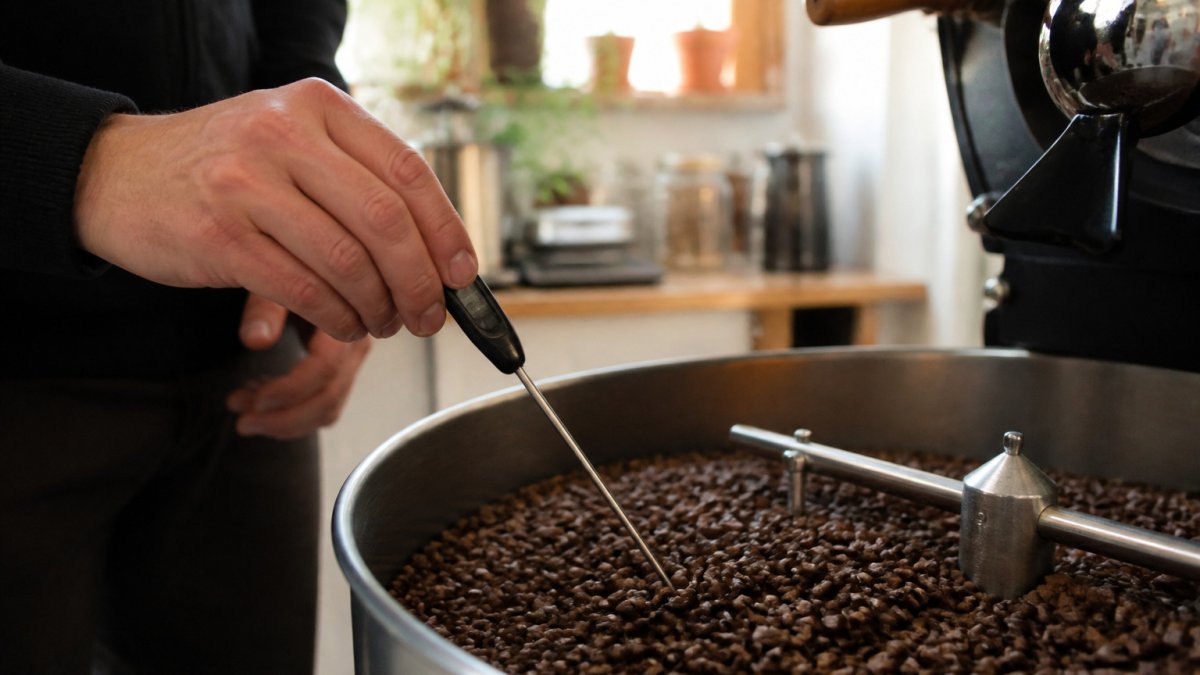
Many home roasters watch the drum temperature because it is the number their machine displays most prominently. For precision work, the more useful figure is bean temperature, the heat inside the bean mass itself. Drum temperature tells you how hot the environment is. Bean temperature tells you what is actually happening to the coffee.
The gap between the two is considerable, especially early in the roast when the cold charge pulls heat out of the drum. A drum reading that looks stable can hide a bean temperature that is climbing too slowly or too fast. Logging bean temperature across the whole roast reveals the rate of rise, the turning point and the moment development begins, all of which shape flavour more than any single setting.
If your roaster does not provide a bean temperature probe, it is worth considering one. Measurement limits matter here: probes sit at a specific point and can read unevenly across a batch, so treat the figures as a consistent guide rather than an absolute truth. Consistency between roasts is usually more valuable than perfect accuracy.
Building a Coffee Roast Profile: Drying, Browning and Development
A roast profile is a time-and-temperature record of a roast. Most profiles move through three broad phases. The drying phase drives off water and is largely about heating the bean evenly without rushing it. The browning phase is when the bean changes colour and the first aromatic compounds begin to form. The development phase follows first crack and is where the final character of the coffee is shaped.
What matters for precision is the rate of temperature rise across these phases, not just the endpoint. A steady, controlled rise through drying and browning tends to produce a clearer, more balanced cup, while a rush early on can leave the bean underdeveloped inside even if the outside looks finished.
A useful habit is to log every roast, noting the green coffee, batch size, rate of rise and the time of first crack. Over time that log becomes your reference for adapting profiles to new beans, which matters because green coffee variables change from lot to lot.
Fellow Opus 2 Conical Burr Grinder - Black →
The Maillard Reaction and Caramelisation in Coffee
The Maillard reaction is a set of chemical reactions between amino acids and reducing sugars, driven by heat. It produces many of the browned, savoury and sweet aromas associated with roasting, and it is a central part of why roasted coffee tastes so different from green. Caramelisation is a separate process, involving the breakdown of sugars alone, but the two overlap during roasting and are often discussed together.
For precision roasting, the practical point is timing. Maillard activity is strongest in the browning phase, and pushing that phase too fast can limit how fully these compounds develop. Equally, extending it without control can produce dull or baked flavours. Sweetness and body are closely tied to how well these reactions are managed, which is why roasters talk so much about the balance between browning and development.
The chemistry here is complex, and published research on coffee roasting is still developing. Treat any single chemical explanation as a simplification of a very active research area.
Coffee Roast Development Time and Its Effect on Sweetness and Acidity
Development time is the period between first crack and the end of the roast. It is one of the strongest levers a roaster has over sweetness and acidity. Shorter development tends to preserve brighter, more acidic notes and a lighter body. Longer development generally builds sweetness and heaviness, but can also flatten the fruit character of a delicate coffee if taken too far.
That is a useful corrective for home roasters chasing a number. Get the curve stable first, then use development time to fine-tune how sweet or bright the cup tastes.
Measuring Accuracy, Repeatability and Troubleshooting Roast Defects
Precision only means something if it can be repeated. Measurement is the foundation: thermometers, probes and scales all have limits, and a roaster who knows those limits will read the data more sensibly. A probe in the wrong position, or a scale that drifts, can send you chasing problems that are not in the roast at all.
Repeatability depends on controlling the variables you can. Weigh every batch, log the green coffee and the settings, and use the same charge temperature each time. Grind consistency matters just as much once the coffee is roasted. If your espresso tastes different day to day, the cause can be the grinder as well as the roast.
When defects appear, work backwards through the log. Baked or flat flavour usually points to development that ran too long or a stalled curve. Sourness often means the roast was ended too early. Uneven colour can signal airflow or charge problems. The log is what turns a vague complaint into a specific, testable hypothesis.
Applying Precision Roasting Principles to Your Next Bag of Beans
Once you understand the variables, the practical step is to apply them to the coffee in front of you. Start by reading the origin and process notes, then choose a roast level that suits the bean rather than a default. A delicate single origin usually rewards a gentler development, while a denser bean may need more energy to reach balance.
If you enjoy experimenting, Coffee Prototypers offers a rotating set of experimental roasts, which makes a good test of how well your understanding travels across very different coffees. Whichever bag you choose, log the results, change one variable at a time, and let the cup, not the theory, decide what works.

Frequently Asked Questions
What happens to coffee beans during roasting?
Green coffee beans lose moisture during the drying phase, then begin to brown as sugars and amino acids react. Between roughly 150 and 200 degrees Celsius, starches break down, sugars caramelise and aromatic compounds form. The beans expand, lose mass through water and carbon dioxide, and change colour from green to yellow, then cinnamon, then brown. Each of these changes can be tracked on a roast profile, which is why logging temperature and time matters for repeatable results.
How does roast temperature affect coffee flavour?
Roast temperature and roast time together determine how far the chemical changes in the bean progress. Higher heat early in a roast tends to produce more aggressive development, while a gentler rate of rise keeps delicate acidity and floral notes intact. Lighter roasts usually retain origin character, and darker roasts push toward bittersweet, roasted flavours. Small changes in the rate of rise can shift sweetness and body noticeably, so consistent control of heat is central to flavour.
What is the Maillard reaction in coffee roasting?
The Maillard reaction is a set of chemical reactions between amino acids and reducing sugars that occurs as the bean heats. It creates the brown colour and many of the aroma compounds associated with roasted coffee, including nutty, caramel and chocolate notes. It runs alongside caramelisation, which involves sugars breaking down on their own. Roasters influence how much Maillard development occurs by controlling temperature and time, which shapes the final cup.
How long does it take to roast coffee beans?
A typical home or small-batch roast takes between 8 and 15 minutes from charge to drop, depending on batch size, bean density and the target roast level. Light roasts are usually finished sooner, while darker roasts run longer. The portion between first crack and the end of the roast, often called development time, is commonly expressed as a percentage of total roast time. Tracking this ratio helps roasters compare batches, though it should not be treated as a fixed target.
What is the difference between light, medium and dark roasting?
Light roasts are stopped shortly after first crack and keep more of the bean's original acidity and origin character. Medium roasts develop more sweetness and body while still showing some origin flavour. Dark roasts are taken further into development, producing bittersweet, roasty flavours and oily surfaces, with less distinct origin character. Each level suits different brew methods and palates, and the same green bean can taste very different at each.
